One of the ways I plan for next year’s garden is to take a look around, make notes & gather ideas from other gardens. This is particularly helpful in planning the fall garden.
I look for what plants have continued to hold their own & still look beautiful into this time of year. I avoid looking for suggestions at the nurseries & gardening centers because those plants have been coddled, fed, trained, trimmed & produced specifically to entice you to buy them as your own garden fades.
Instead, I look at the gardens of my friends. Which plants are in bloom & in which colors? Which have stood the ravages of a long season of pests, fungus & weather to still look stunning? Which plants have resisted the need for staking & other high maintenance gardening chores?
Here are a few of the choices you’ll find in the fall garden:
Chelone lyonii 'Hot Lips'
Chelone lyonii ‘Hot Lips’
Turtlehead
This cultivar is a bit shorter than the Chelone oblique & the pink color a bit brighter. It needs no staking & reliably blooms for weeks on end. The dried heads look stunning in the winter sun as they’re popping up through the snow.
Angelica gigas
Angelica is a sturdy biennial, which reseeds conservatively in the mixed border.
This chest high specimen blooms on tall stalks with purple broccoli like flowers adorning them for weeks on end. Just be careful not to lose them by being to earnest in your springtime weeding or you’ll miss out on this fall wonder.
Kirengeshoma palmata
This 4’ tall and 4’ wide no maintenance fall blooming plant sports pearl like buds of yellow flowers in the shade garden. No staking, no pruning, no pests. Just sturdy, reliable performance.
Call your friends. Visit your neighbors. See what’s blooming in their gardens as you plan for next year’s fall extravaganza.
Plectranthus and other members of the Lamiaceae family, like Coleus, are easy to propagate. These tender perennials are not hardy in my Zone 6 garden so before frost I bring in a few of my favorite plants as stock plants. If the plants are small enough I overwinter them in a pot with soil and towards the end of winter I begin propagation. If the plants are too big outside in the fall I proceed to take cuttings and begin propagation at that time.
An apical cutting of Plectranthus ciliatus ‘Zulu Wonder’
Whether I begin this process in the fall or late winter, this is how I propagate my square stemmed plectranthus and coleus. I prefer to begin the process later rather than sooner since it makes the house less cluttered.
I use my fingers rather than scissors to pinch off the leaves because that gives me more control over how close I can get to the stem
I cut sections off the host plant making sure that I have at about 5-7 leaf nodes. Then I pinch off most of the remaining leaves right to the stem taking care not to tear stips. Since the leave nodes are opposite, I leave only 2-4 nodes depending on the spacing between them on the stem.
Once I cleanly remove the excess leaves I discard them
I take off so many leaves since I want the energy of the plant to got towards root production rather than transpiration. I cut the stem to a length of 4-6 inches, making sure that I cut the stem just below my final node.
I like keeping the glass on my windowsill in the kitchen so I can enjoy watching the roots grow
I leave the stems in a glass of water on my windowsill in the kitchen for a few weeks making sure to keep the water clean and the glass full. Once there are a sizable number of white roots and root hairs visible I plant each of the stems into a pot using fresh pro-mix potting soil. I place a bit of soil at the bottom of the pot, sprinkle in a bit of timed release fertilizer and then top it off with more soil to within about a half inch toward the top of the pot.
I try to keep the water clean and high enough on the nodes to develop more and healthier roots
I make sure as I’m sprinkling the soil around the roots that they are evenly spaced and not cramped. I continue to water them without letting them dry out in their pots.
Wherever there is a leaf node submerged in water the roots will develop
This propagation process always gives me a great feeling that spring is in the air even when there’s still snow on the ground.
(If you’d like to follow this project from the beginning you can start at Step 1 here)
Step 15 of Rear Garden Design Project.
So now that I measured the space, researched on the web, selected and took delivery of the bridge from GazeboCreations.com it is time to assemble the parts.
First you assemble the struts on a flat surface
Fortunately my son Michael gave me a Mother’s Day present of one day of labor. First he put together the base on the flat surface of the driveway.
Using a level to make sure the structure is balanced is critical to the entire process
Then he put the struts across the dry stream bed and used a bubble level to make sure that it was even both front to back and side to side. This is a very critical stage to the entire project.
All the holes are predrilled and make the assembly much easier to understand
Once the base is level and in place he attached the pre-drilled flooring in place. We used a thin nail as a spacer on each end of the boards to give some room for expansion as the boards swell with moisture. We attached the first board and then placed each successive board so we were sure of positioning before we attached them with screws.
It was useful to have two people to put the handrails together
By this time my husband Dave came home and couldn’t keep himself away from the project so he joined Michael in putting up the side rails. Each part of the bridge kit was clearly marked and pre-drilled for easy installation. Nevertheless, the assembly took hours to complete. The second time would have been much shorter.
I’m so happy to finally, after 9 years, have such a beautiful woodland setting
My son Michael was pleased to have the project over and next year I’ll probably get a pot of marigolds for Mother’s Day. It will be much easier for him.
My son Michael is happy the project is over.
After 9 years of waiting I’m so very happy with the outcome of the project. The bridge is such a perfect complement to the natural feeling of the woodland walks I’ve designed.
(If you’d like to follow this project from the beginning you can start at Step 1 here)
Step 14 of Rear Garden Design Project.
I searched online to find a garden bridge to replace our nine-year-old “temporary” bridge and I found a good selection at: gazebocreations.com.
I selected this bridge style from GazeboCreations.com
I measured across the dry streambed to determine the length I needed to cross the span. The website had very good information about the span size and other stats I needed to make my selection.
It was important to have a bridge that was the right scale for the project, a Goldilocks bridge, not too small, not too big, just right.
I ordered it online with the added options of stainless steel screws and 2 Coats Cedar Stain/Sealer to ensure greater longevity. This bridge has to last a lot longer then the temporary one did.
The boxes arrived by UPS and when I unpacked them I checked the parts list to make sure everything was there. It was complet I’m happy to say.
The bridge parts arrived well packaged and easily inventoried
We dismantled the “temporary” bridge that was always such a joy to the grandchildren on a day they weren’t visiting so the work went more smoothly. I thought I’d be nostalgic but I was far too happy to be finally getting a real garden bridge that I didn’t waste a moment dwelling on the past.
My son Michael helped to dismantle the nine year old “temporary” bridge
(If you’d like to follow this project from the beginning you can start at Step 1 here)
Step 13 of Rear Garden Design Project.
Now that I finally, after 9 years have my back entry stone walls and dry stream bed installed it is time for the decorating to begin.
For all these years we’ve been using what was supposed to be a temporary bridge. In 2000, when we originally began this project the construction crew built a plank bridge by hammering a few weather treated boards together and putting them over the dry stream bed.
My own grandsons have been born since the temporary bridge was originally installed and have grown up with the joy of bouncing wildly on the planks, much to the dismay of fathers, mothers and grandparents. Their utter joy in the flexibility of the boards and the semi dangerous and enthusiastic experience has provided untold hours of glee.
I felt somewhat bad for them and wondered how they would react to the disappearance of their favorite playground.
Fear not. They adapted instantly and have gone on to other adventures in the garden. I think they’ve found dinosaurs hiding along the woodland paths.
(If you’d like to follow this project from the beginning you can start at Step 1 here)
Step 12 of Rear Garden Design Project.
March, 2009
I’ve been writing for awhile about the 10 year project of designing and building the rear entry project of stone walls, steps and a dry stream bed. We finally have our hardscaping done. Whew!
This Taxus x media was in this location on the property when I moved in 20 years ago.
During the 20 years that I’ve lived on this property so many of the trees and shrubs have grown, some have matured and some are in decline. I’ve been trimming a massive yew (Taxus x media), over and over each year to try to keep it contained within the scale of the property.
Sometimes a gardener has to make the tough decision to eliminate in order to renovate
Once the walls were installed and I began to enjoy the prospect of planting it became abundantly clear that the yew had outgrown its beauty and positive contribution to the garden. I gritted my teeth and ordered the removal of this venerable shrub since it was far too old and large for transplanting. I was quite saddened by the loss and yet I knew it was the right decision.
The sun shined brightly on the day it was removed on March 12, 2009 and I could see immediately that the removal of this outsized and very dark green hulk opened up the space to new and youthful opportunities.
After the initial shock whore off I was sure I’d made the right design decision to open up the space for new planting ideas
Now if I can only figure out what I want to put there…
(If you’d like to follow this project from the beginning you can start at Step 1 here)
Step 11 of Rear Garden Design Project.
September, 2008
Our landscape project continued to move closer to completion when we finally hired professionals to finish the job we’d begun in the fall of 2000.
The new stone walls conformed to my intial semi-circular design concept
In evaluating the project Billy Ahern of Ahern’s Landscaping, (who is not related to me in any way) decided to take down the walls I’d been trying to build on and off for many years. It is not because the walls I built were unsafe but because we wanted all the walls to match. This would not be the case if half was built by me and half by another person.
The stone steps we built six years earlier were incorporated into the new wall system
We were very happy that the steps my husband Dave and I had built 6 years earlier were judged sturdy and stable and could be incorporated into the finished project. We were and still are proud of the achievement of having completed that part of the project.
What took us years of off and on work, these professionals completed in two days. It was very clear to my husband and me that our careers of pushing keys on computer keyboards didn’t prepare us for the hard manual labor of hardscaping. We were no competition for the hardworking men who build these gorgeous projects day after day. We salute them and their work.
The terraced stone walls opened into the dry stream bed I designed 8 years earlier
(If you’d like to follow this project from the beginning you can start at Step 1 here)
Step 10 of Rear Garden Design Project.
September, 2008
When we finally hired Billy Ahern of Ahern’s Landscaping to finish the project I designed and we started in 2000 he recommended some changes. I agreed with him that the scale of the dry stream bed that I’d designed was too large for the location. He had his men resculpt the walls and add soil. I’d been stockpiling extra soil that was taken from the driveway when I’d had it widened.
The size of the dry stream bed was reduced and brought more in line with the scale of the surrounding garden
The stream was narrowed and brought it into a good balance with the rest of the garden. He reused all the stone I’d dug up from the garden and the extra round river rock I’d purchased years before.
His men put the river rock in the irregular flowing pattern I’d designed and they had nearly enough to complete the dry stream bed. But not quite. We scavenged rock from around the garden but we ended up having to purchase another batch of rock. What a surprise. More rock!
What? More Stone? I’m afraid all this added weight might change the rotation of the earth.
Once the rock walls were in place they put the gravel base in place and put small river rock on top. There is so much rock on this project I sometimes feel that the earth will give way from the weight.
But that is just memories of my aching back.
River rock was placed on the newly sculpted walls.
It is so much easier to sign a check. I wouldn’t feel this way if I hadn’t worked on the project for so long and found that I’d bit off more then I could chew. So now I’m really happy to have help and to come closer to a completed design.
Crushed gravel was put down as a base for the small stone
(If you’d like to follow this project from the beginning you can start at Step 1 here)
Step 9 of Rear Garden Design Project.
September, 2008
We jump ahead on the Rear Garden Design Project from 2002 until 2008. Sometimes life intervenes and projects get put on hold for a while. In the ensuing years I gained another grandson and he grew enough to join my first. They played on the piles of rock, some of which were walls. They particularly have enjoyed bouncing on the bridge planks giving all of us nervous twitches, but they never managed to get hurt.
Bouncing on the boards and climbing on the stone. What fun!
In 2008 I finally bit the bullet and called in the Pros. Billy Ahern of Ahern’s Landscaping in Huntington NY came to the rescue. (BTW. They are not relatives of mine, past or present) He understood immediately what I wanted to create and he worked from my original drawing plans.
The first thing that Billy’s crew did was to dismantle the stone walls I’d built in fits and starts from 2002 through 2007. What took me days of laying one course of stone took the men seconds to undo.
The crew dismantling my carefully and painfully built stone walls.
It was quite dismaying and sad for me to watch the work I’d done disappear. I thought about the exhaustion and pain I’d experienced and all the trips to Nadine O’Neill my Chiropractor and The Pilates Place trying to get my self back in shape.
And then I’d think with optimism how nice it was going to look and I would be able to go back to gardening, not construction work.
Ahern’s crew demolishing everything we’d built except the stone steps
I was also very pleased that Billy Ahern decided to keep the stone steps that my husband Dave and I had so proudly built in 2002. He said that were rock solid. We’re very proud.
(If you’d like to follow this project from the beginning you can start at Step 1 here)
Step 8 of Rear Garden Design Project.
July through November, 2002
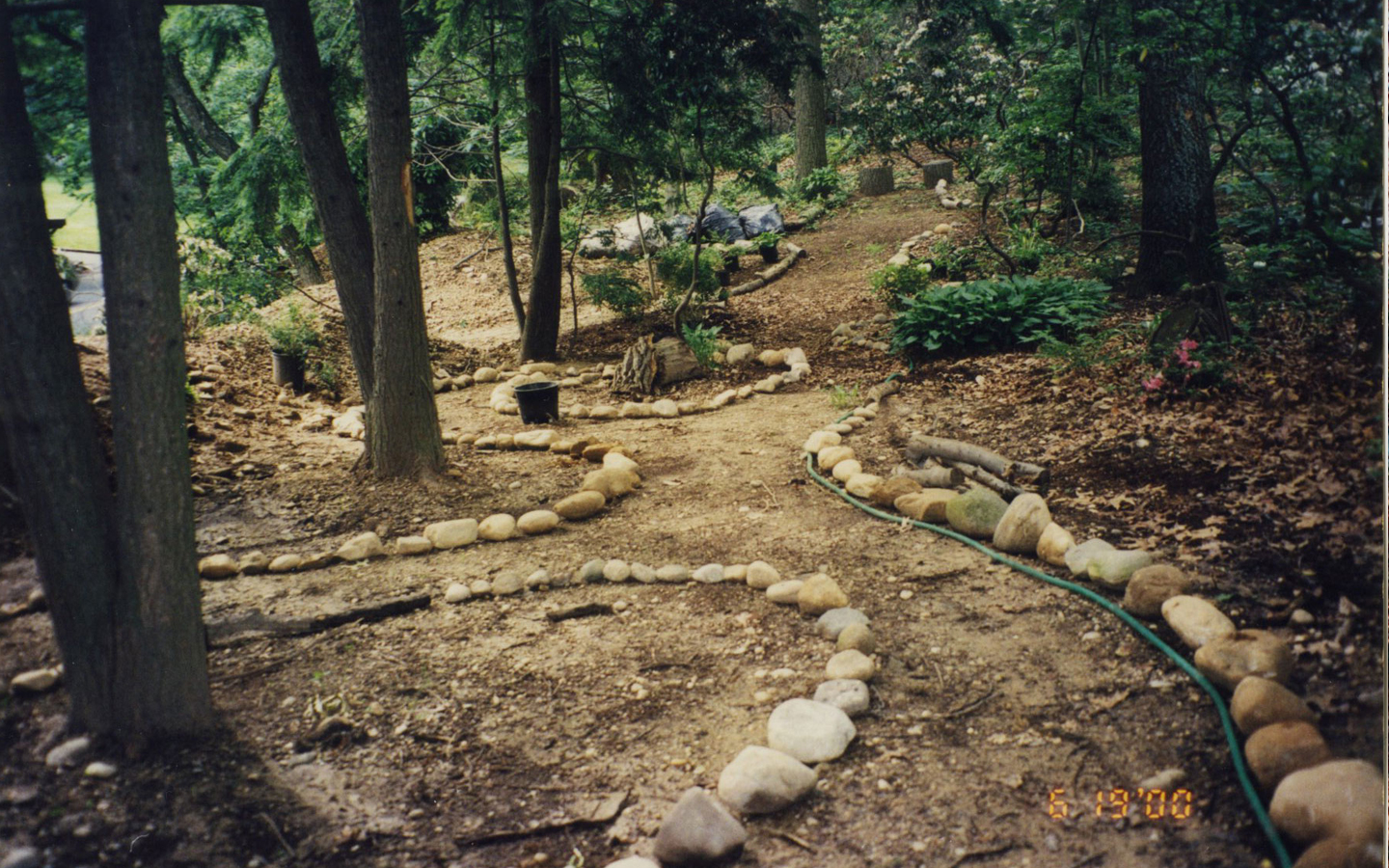
We decided to trash my first idea of continuing the theme of the garden and using round river rock for the walls at the rear entrance to the guest room. What would happen each time it rained was that the soil would creep in from behind the stones and eventually clog up the passive drainage system.
So I dismantled the walls, making a stack of rocks to the left of the door. Using my handy dandy Mantis tiller I excavated the base and leveled it smoothly.
July 7, 2002 Clear the base and level it
I used crushed bluestone to fill the base and give an even and strong working surface to the first base layer of stone.
July 9, 2002 Spreading gravel is much harder then raking a lawn.
I put landscapers cloth down first to keep back the soil and put the first course of stone down. This one is so critical because it sets the tone for the entire wall. I used levels to make sure the row was plumb.
September 8, 2002 Picking the right stones for the puzzle takes a long time
The work was so laborious that I could only work on one or two courses a day and then it would take me a day or two to recover. Thank goodness for my Chiropractor, Dr. Nadine O’Neill in Northport for keeping my aching body going.
November, 9, 2002 The leaves are beautiful, the unfinished walls are not
By the fall of 2002 I had to stop the project because I couldn’t fight the leaves everyday just to get started lifting stone. The project stood at a standstill for quite some time. Years in fact.