My Art Starts In The Garden: Musings on my Life as an Artist
My Art is inspired by the gardens surrounding my studio. There is a complexity to my work in both the spiritual and technical parts of my mind. Enjoy this meandering journey with me. The highs, the lows, inspiration, ideas, techniques and general musings about the complicated creative life of an Artist.
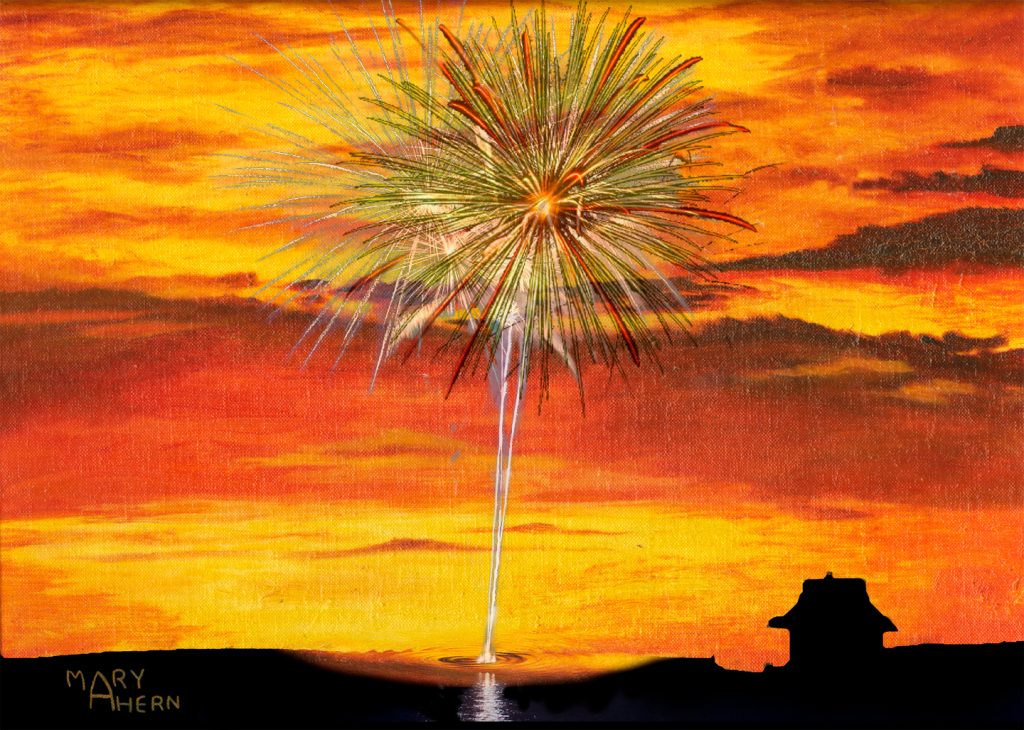
Rocket screaming energy propels me from a watery grave.
Into the Red-Orange Sky.
Illustration: Oil painting with digital overlays in Photoshop.
I wrote this piece on May 15, 1978. My marriage was ending. I was about to become a single mother to two young sons, and I was terrified. Since marrying at twenty, I had not worked outside the home. I was facing a frightening future with no particular skills for earning a living. Visions of starvation and homelessness enveloped my very being every day and every night.
But there was a core deep inside me that propelled me. A belief within me that I was born with. A silent confidence. Not something I was groomed from childhood to believe. Not something that was instilled by outside forces. Certainly not something that was supported by outward measurements of success.
I somehow knew I’d find a way to make a life, a good life, for my little family of three. Because of this core belief in myself, I did make that life for us. There were setbacks, tight money in the supermarket at the end of the week, long hours of commuting to a decent job, the heartbreaking sadness my sons were feeling at the loss of their nuclear family. I propelled us forward through energy, flexibility, intelligence, planning, and complete commitment. I refused to be a victim of circumstance but to make my own future.
I did in fact, propel myself out of that watery grave. I showed my sons that I could work hard and build a career. That starting over is not an end, it’s a beginning.
Notes on the illustration: In September of 1974, “The Red-Orange Sky” is the first oil painting I ever made. I was taking Wednesday evening art classes at the YMCA near where I was living in Queens Village, NY. Each week, all the students brought in calendar photos to use as models. A year later, I enrolled in college to major in art.
On November 16, 2013, using Photoshop, I digitally added the rocket explosions and fireworks to the oil painting image to illustrate this earlier writing of mine.
This is a reprint of an article initially published by Bold Journey Magazine on December 29, 2025.
Mary Ahern shared their story and experiences with us recently and you can find our conversation below.
Hi Mary, thank you so much for taking time out of your busy day to share your story, experiences and insights with our readers. Let’s jump right in with an interesting one: What is a normal day like for you right now?
Most days, I wake up without an alarm, and before I get out of bed, I enjoy a 30-minute stretching and meditation routine. Then I shower, have coffee & read the news on my laptop. Each day that the weather permits, I spend time in my garden either working, photographing, or just seeing and enjoying. By mid-afternoon, I head to my studio for hours of painting or drawing.
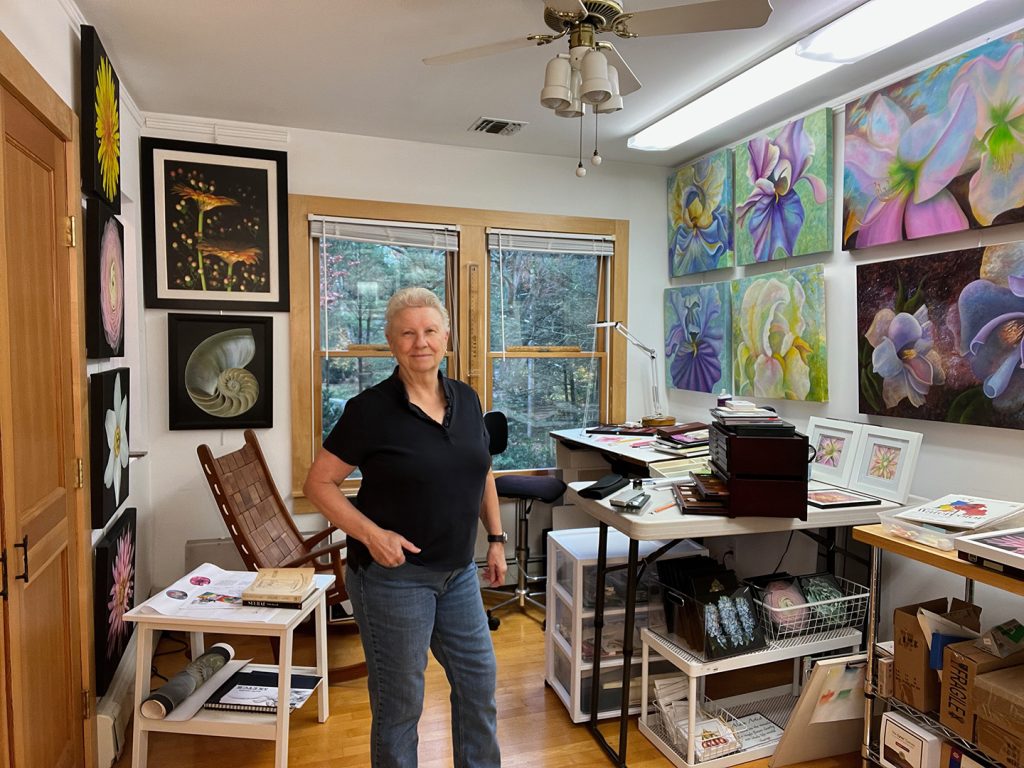
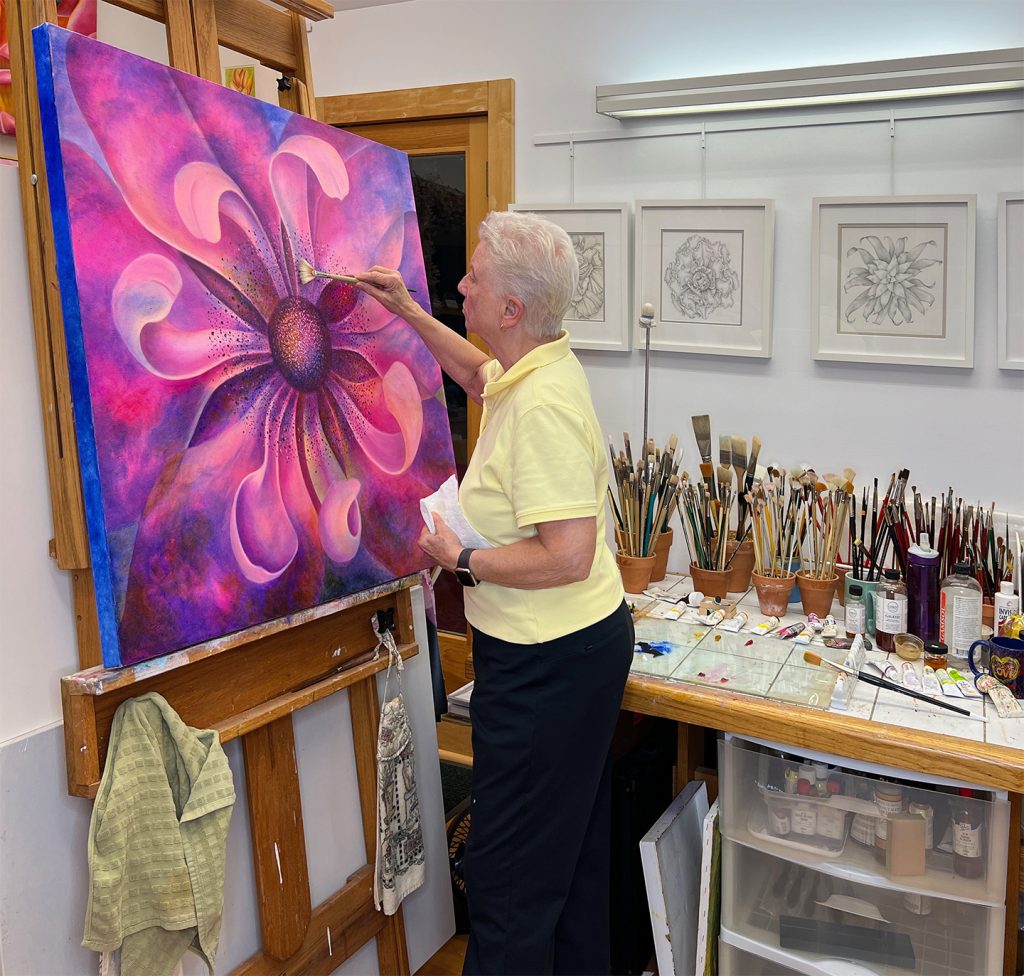
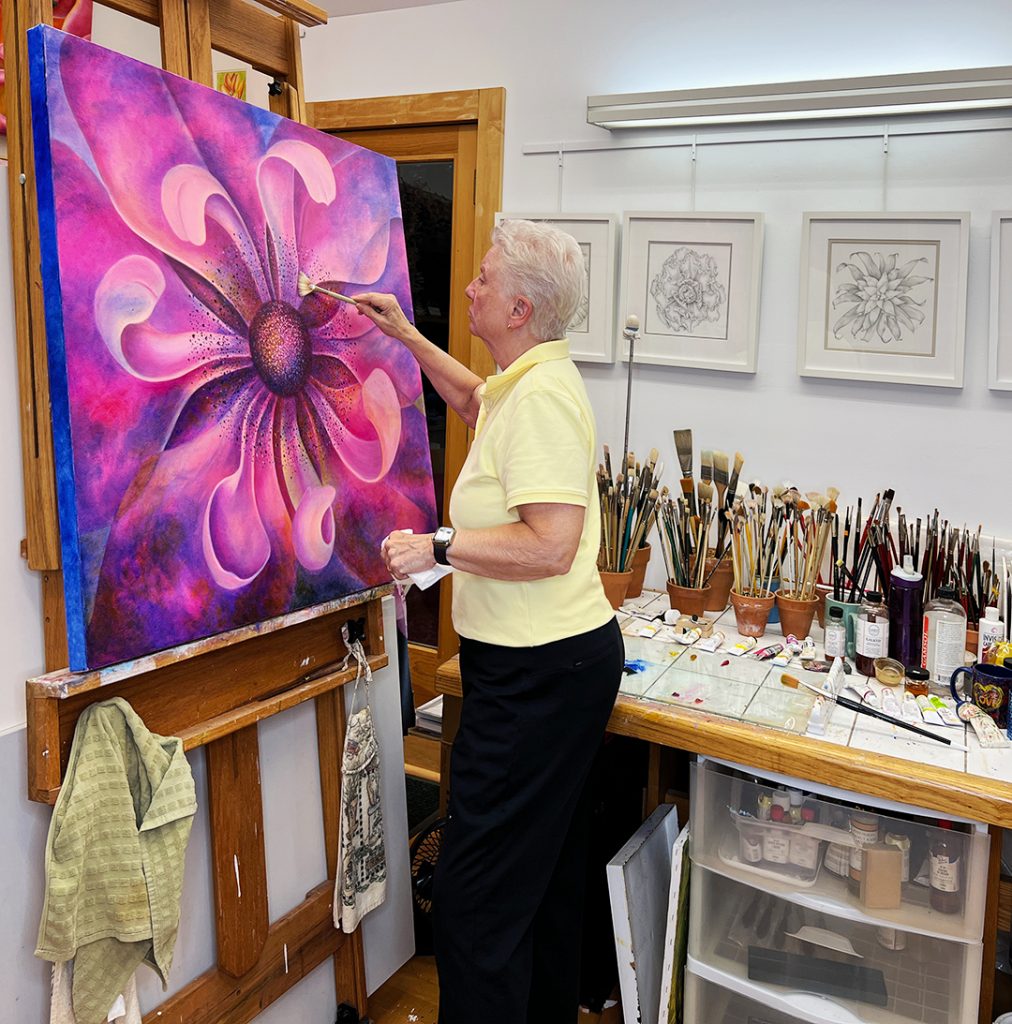
Standing in my drawing studio, which overlooks my front garden.
The slow start to my day begins the process of staying fit, both mentally and physically, in order to continue my decades-long practice of creativity. Connecting with my garden is critical, as it is where my artwork’s inspiration comes from. My two studios are custom-built in my home, allowing me total immersion in all aspects of the life I live and work in. They are seamless.
Can you briefly introduce yourself and share what makes you or your brand unique?
I am an artist with a fifty-year career in many forms and mediums of creativity. I began as an oil painter in the 1970s. During the 1980s and 90s, I moved into digital work as a career, first selling computer graphics equipment and later establishing my own graphic design business. No matter where I lived, I always carved out a studio for myself.
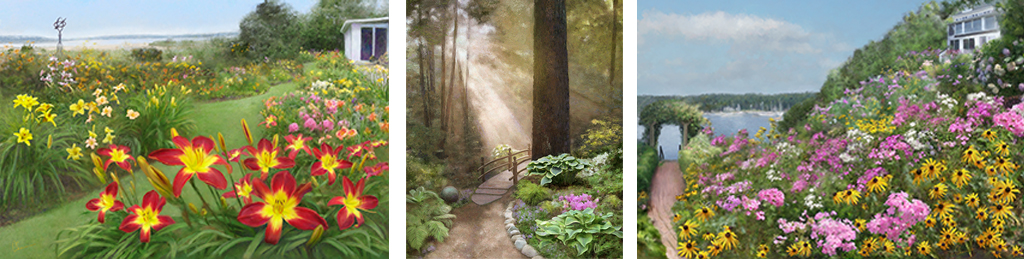
In the early 2000s, using a professional-leveI scanner, I captured live flowers from my garden, then composited the images in Photoshop. From these images I created what I called Designer Prints which I sold online and in art festivals in six different states. I created digital paintings of garden landscapes using Corel Painter. I programmed custom digital brushes to mimic the oil painting brushes I use to create my oil paintings on canvas for this artwork.
Over the past decade, I’ve returned exclusively to oil painting. What hasn’t changed is the inspiration I draw from my extensive garden, which I’ve designed and tended for over 35 years
Work in Progress – “Cosmic Iris Squared”
Amazing, so let’s take a moment to go back in time. Who were you before the world told you who you had to be?
I was raised in Brooklyn, NY, in a very strict old European environment with no vision beyond being a wife and a mommy. Though I graduated from high school with academic honors, my family offered no further education, believing that educating women was a waste of money. Throughout Junior and Senior High School, I was in the orchestra and band music programs. At graduation, I conducted Beethoven’s Fifth Symphony, having been awarded the music department honors. That was the final act of my musical career. With no further educational or career opportunities in my future, I married and had two sons.
In my later 20s, I began to draw. Never having had art classes in school because of my involvement with music, this was a completely new experience for me. From the moment I picked up a piece of charcoal and put it to paper, I felt like it was an extension of my own body. I began taking oil painting classes on Wednesday evenings at the local YMCA. A college professor friend of mine suggested I apply to college to study art. At the time, I didn’t even know a person could go to college as an older student. I applied. Was accepted. And my life changed dramatically.
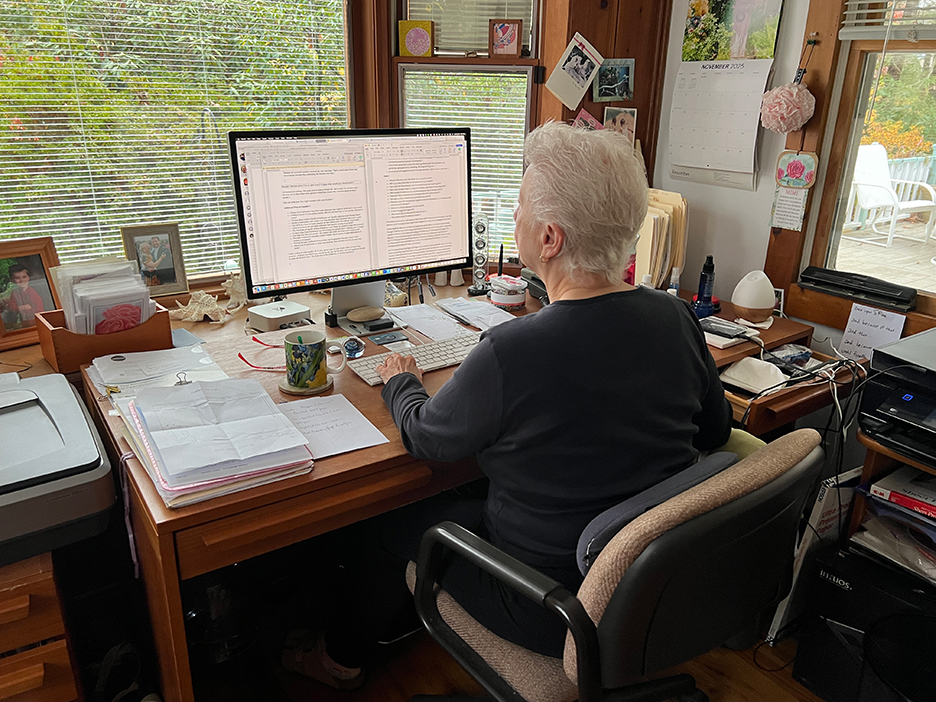
Sitting in my office, surrounded by 3 views of the garden where I work and write.
Do you remember a time someone truly listened to you?
I have been fortunate in this respect. I have had the benefit of several mentors and role models throughout my life’s journey. My friend Roberta, who told me I could and should go to college. Mary Ann, who showed me women could be executives, wealthy, and own sports cars. Martha, my mentor and boss, who steered me into a career in computers in the early 1980s, when this field was just dawning. This beginning opened a pathway into high-end technology sales, a field not populated by women and therefore better paid.
Work in Progress – “My New World – Anemone Redux”
Sure, so let’s go deeper into your values and how you think. Is the public version of you the real you?
People who don’t really know me get me all wrong. My public persona has been sculpted by the challenging life and career I’ve experienced. Having worked as a single mother, in an almost totally male industry for quite a while, I’ve developed some of that style of speaking and traits such as assertiveness, competitiveness and confidence. Add to that the fact that I’m of Dutch heritage, which means I’m direct, opinionated, and rather straightforward. Many people, particularly women, misunderstand this about me.
My friends know me as a sensitive and empathetic human being. Generous and helpful with my time and energy when I believe I can make a difference. I’m serious and don’t engage in small talk, pop culture, or time fillers. I am easily bored. I have always, and continue to, take classes and workshops to expand my knowledge of a variety of subjects, including art, art history, horticulture, marketing, and writing.
I also have a balance between left- and right-brain thinking, which helps me in both creativity and logic. Though unusual in most artists, I enjoy this aptitude immensely.
Before we go, we’d love to hear your thoughts on some longer-run, legacy type questions. If you knew you had 10 years left, what would you stop doing immediately? Since I’m already 78, this is more of a question of what I have already stopped doing. When I turned 70, I closed my commercial graphic design business, although I still have a few legacy clients. Earlier this year, I resigned from a PR Chair position at a non-profit I had been dedicating about 30 hours a week to for the past 5 years. Working in a non-profit easily becomes a full-time job before you realize it because it is usually in an area in which you have passion.
I have replaced these efforts with a concentration on my own creativity. As an artist, I now have two solo exhibitions scheduled for next year and one for the year I turn 80. Creating that much artwork requires a full dedication to working in my studio every day. I am finding it liberating to focus entirely on my own work. I’m glad I made this choice! I’m glad I made this choice!
Recently, someone who came to my studio looked around at all the walls and asked whether I only ever paint flowers. The question stopped me in my tracks. It seemed like a judgment. That somehow, I was a limited artist who couldn’t paint anything else. I guess the word only made a difference to me. Every once in a while, I’ve heard this type of statement, but for some reason, this time it struck a chord with me. Perhaps it was because the person who asked it was also an artist.
Since this visit, I’ve been ruminating about her question. I wonder whether artists who only paint portraits of people or pets are also questioned as to their output? Are non-objective abstract artists asked whether they only paint abstracts, or are they able to paint in other styles?
I recall when I first began studying art and art history and saw the early drawings of Willem de Kooning, being quite surprised when I realized he was an excellent draftsman. Before seeing that early work of his, I thought he painted abstractly because he couldn’t draw. But I was young.
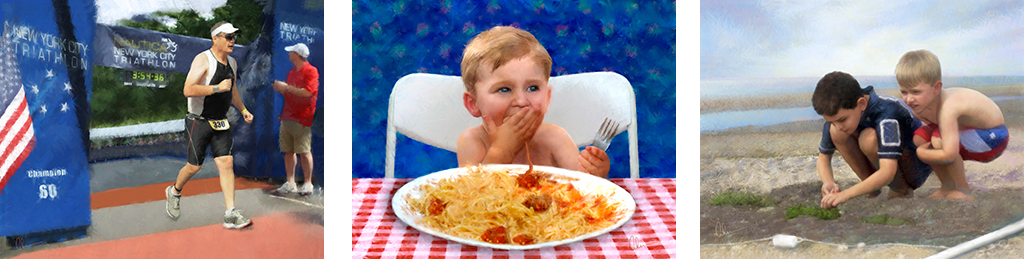
Some paintings of mine from the early 20002 featured people.
I learned quickly that artists are called to their work by forces beyond competency alone. The choice of their style or subject matter is often a calling to some higher energy source, emotional pull, or intellectual pursuit. The final artwork is a key to appreciating the depth of the artist’s inquiry and evolution.
Artists often work in a series while exploring concepts, mediums, mood, and life circumstances. Had this artist visited my studio in the 1970s, she would have asked if I only ever painted windows. In the 1980s, 90s, and early 2000s, the question might have been whether I only worked digitally. A few years later, she might have asked if I only painted portraits or gardens.
Each artist’s work, including my own, evolves over time. Some are due to life changes, personal or emotional. Others are due to changing interests or insights into questions the current work has amplified. Some series of work may reach an impasse or closure.
Over the fifty years I’ve been creating, my art has reflected my ever-changing life. My interests and needs have evolved, and my work has reflected some of those changes. There were personal losses, anger and fear, as well as broader political concerns, financial ups and downs, career paths that led to leaps in skills, changes in physical fitness, and obstacles to overcome. There have been time pressures that can influence what mediums I choose to create my work.
Over time, my paintings focused upon gardens, my own and those of my friends.
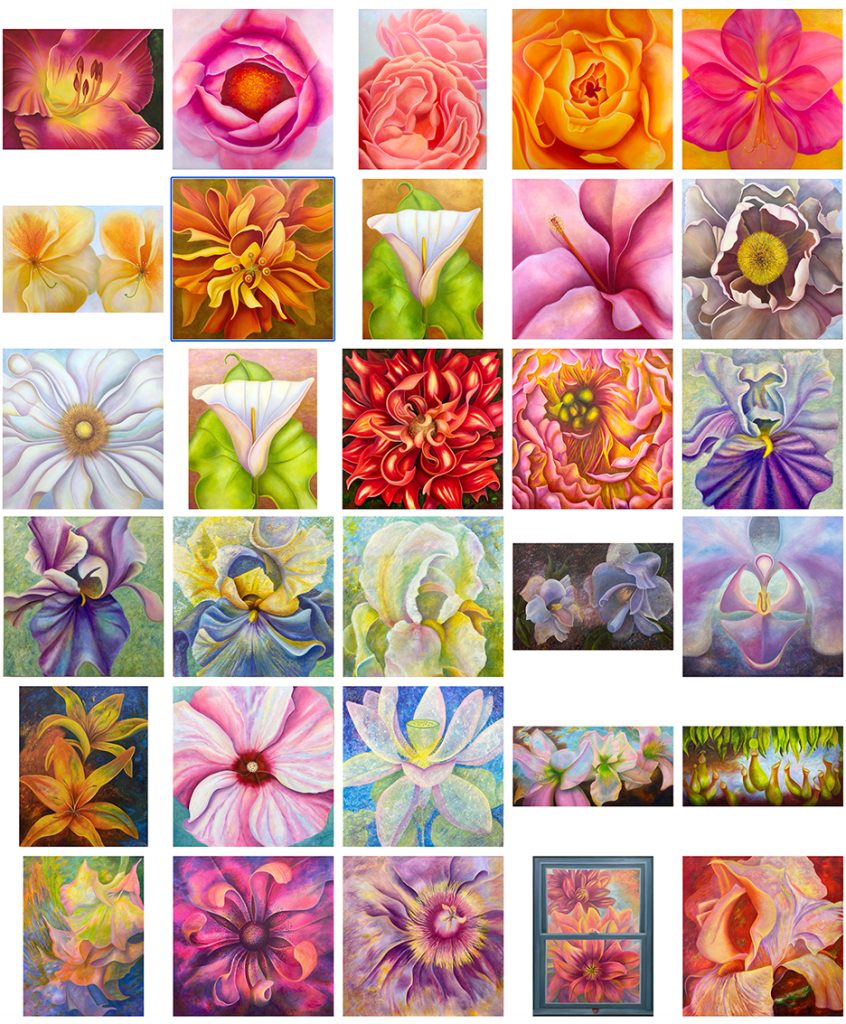
For the last eight years, I’ve been painting large flowers in oils, most of them bursting outside the edges of the canvas with energy. Each of these bold flowers has a different story to tell. Every one of them has arrived with a new challenge. Sometimes, years after I’ve completed and signed a painting, I return it to the easel since I feel it has new things it wants to say. As I continue to evolve, these flowers also take on new directions.
A few years ago, having made a conscious decision to calm the hectic pace of my life, close down the commercial side of my art, and spend more time creating for myself, my artwork changed yet again. I returned to my first love, oil painting. This decision also allowed more quiet time for reading, reflecting, and listening. As I continued to evolve, spiritual and intellectual awakenings increasingly inform more of my work. Embedded in my large flower paintings are layered the ideas and emotions surfacing in me at that moment. Tomorrow or next week, I might be thinking other thoughts, and my art will follow that thread of ideas.
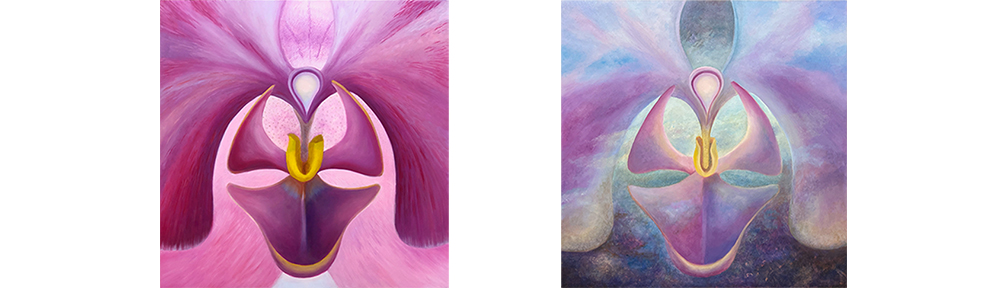
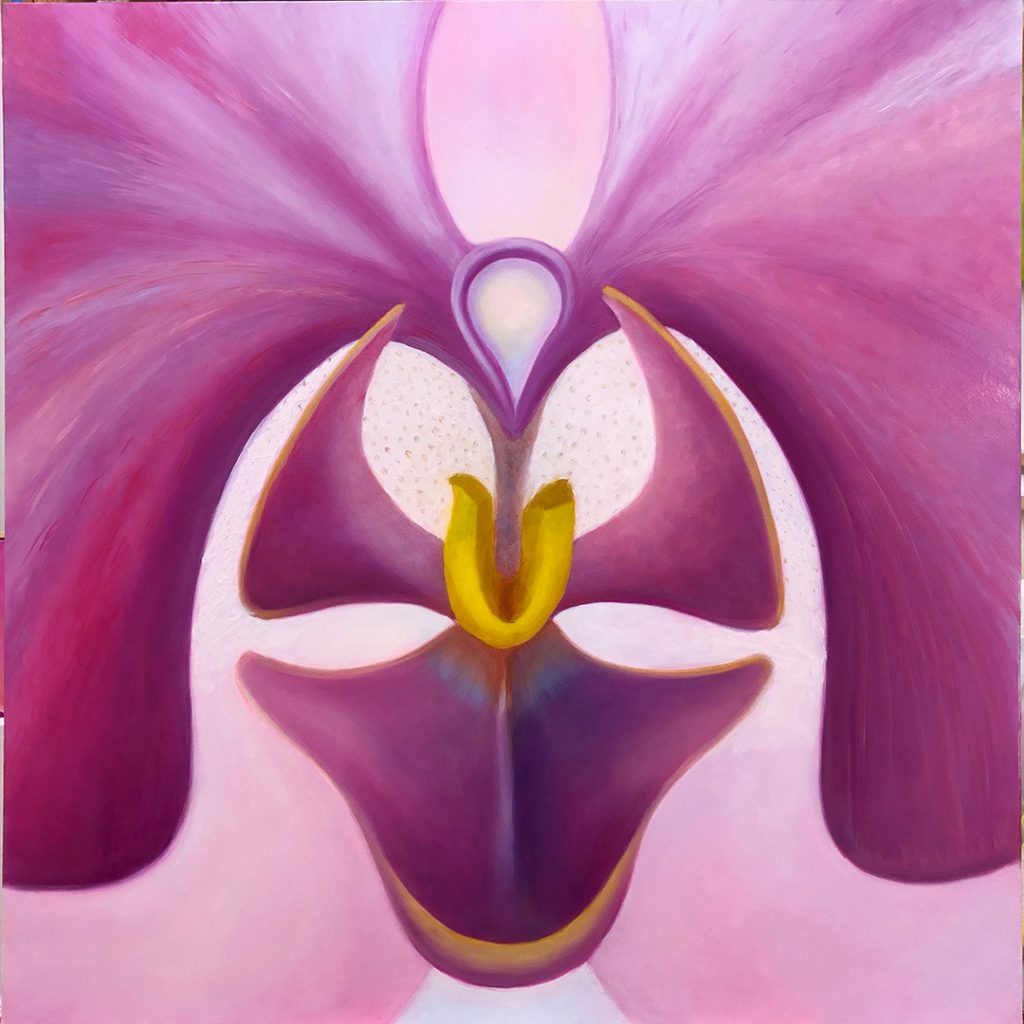
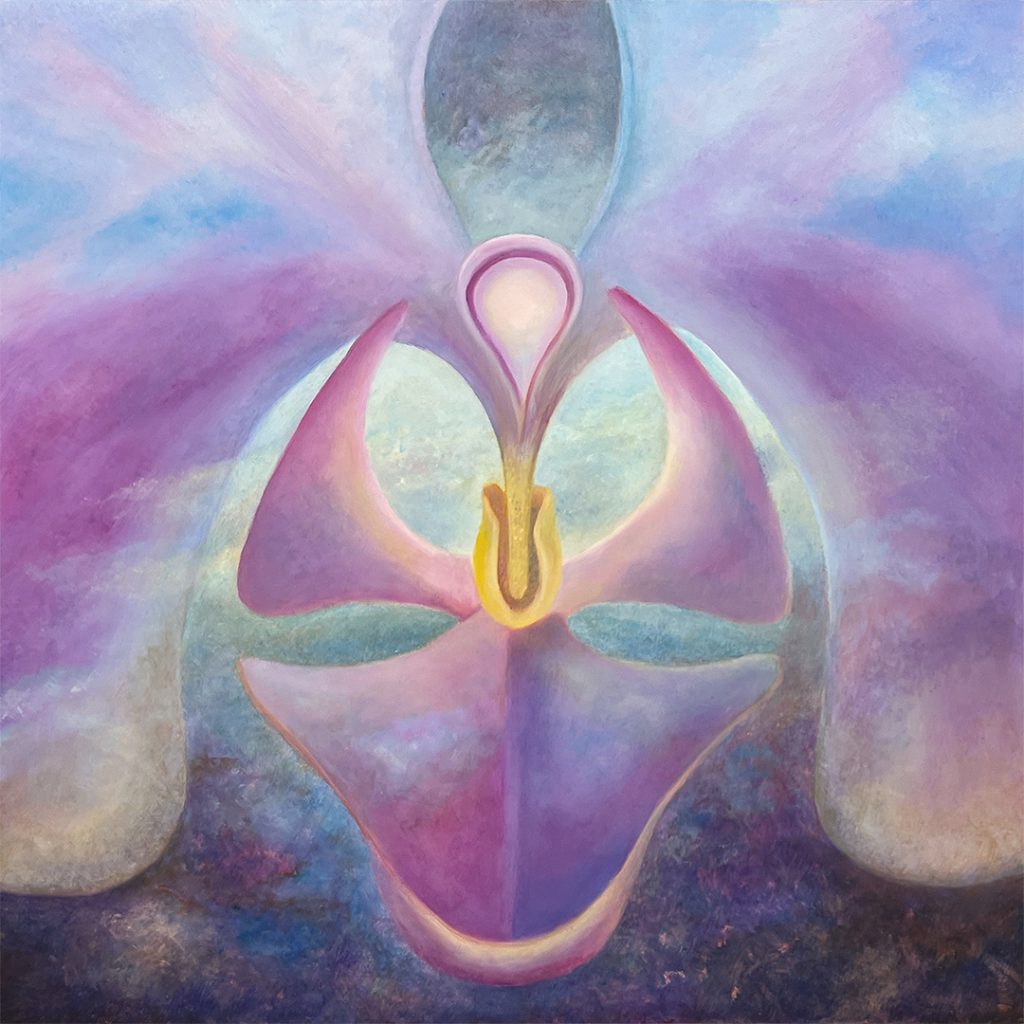
The Purple Phalaenopsis Orchid on the left was painted in 2021. In 2023, I repainted the orchid with added inspiration from the NAWA Cosmos images I had been studying.
Part of the responsibility of being an artist is that amazing opportunity each day to reflect change. Change in thinking, emotions, feelings, or awareness, or change in circumstances, physical or financial. Those changes absorbed by the artist don’t necessarily trigger massive, recognizable alterations in an artist’s work. Over time, perhaps years or even decades, they slowly transform the outcome. Looking back over my fifty years of creating art, I can read the threads of my biography weaving the story of my life.
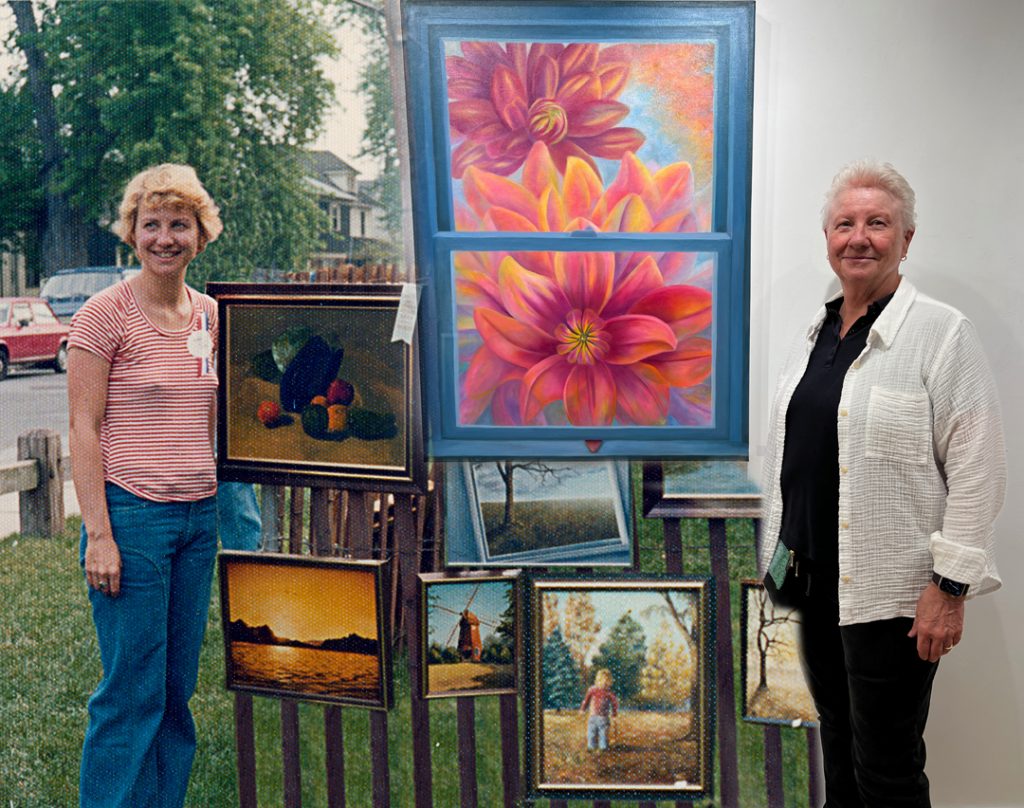
Mary Ahern-Left: Floral Park Art League Exhibition -1975 and Right: Ceres Gallery, Chelsea NY Exhibition-2025
For those of us who were told we couldn’t be a Real Artist if we were a woman.
For those of us who were told we couldn’t be an Artist if we were married.
For those of us who were told we couldn’t be an Artist if we were a mother.
For those of us who were told we couldn’t be an Artist if we were divorced.
For those of us who were told we couldn’t be an Artist if we held a full-time job.
For those of us who were single parents, raising kids alone, and still creating Art.
For those of us who were told we couldn’t be a serious Artist if we were a grandmother.
For those of us who took out our paints every day to work on the dining room table after the kids went to bed.
For those of us who worked on plaster casts of our sculptures in the kitchen when the kids were playing underfoot.
For those of us who made crafts to sell at garage sales to make money to buy our fine art supplies.
For those of us who began painting at 10 pm when the workday was over, the dinner was eaten, the dishes done, the homework checked, the baths completed and the kids in bed.
For those of us working to put food on the table but still making our Art in the moments of leftover precious time.
For those of us whose only personal time, in between taking care of others, was while we were making our Art.
For those of us who have always found creative workarounds so we can make our Art.
For those of us who put one foot in front of the other and continued to make Art for over 50 years.
For those of us who listened to our inner Artist and shut out the cacophony of negativity.
For those of us who continue to create to bring our inner strength, our inner thoughts, our inner courage to share with others.
For those of us who didn’t wait for permission to call ourselves Artists—we just kept creating.
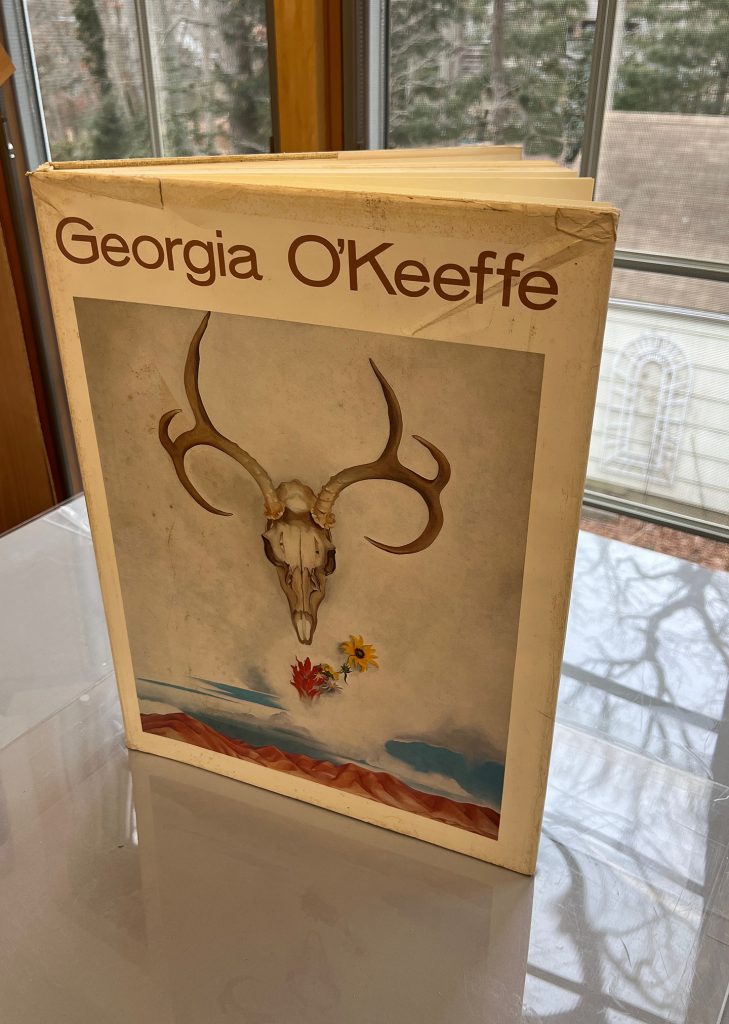
The Christmas Present in 1976 that introduced me to Georgia O’Keeffe
Because I paint large flowers, people naturally say, “Oh, you must like Georgia O’Keeffe.” What they don’t know is that Georgia’s work drew me in not through her flowers but through her abstractions and her skulls. The sensuality of her forms triggered me. I was moved deeply by her lightened color palette. I’d never seen paintings that had that lightness, that buoyancy. They had a girlie-girl feel to them. I didn’t have the language to understand what moved me at the time. I probably still don’t. But her work made me feel like a woman—a soft, light, gentle free spirit.
I was a late starter, going to college at the age of 27. My youngest son was going to preschool, so I had some time to pursue something besides being a mommy that grabbed my soul. I began a YMCA oil painting class, and my teacher, a generous, gifted, and kind French woman, urged me to study in more depth. She saw something in me I didn’t know I had.
On Christmas in 1976, I received a present that changed the course of my life. It was the first coffee-table book published by Georgia O’Keeffe. On the cover was a stunning painting of a skull that changed everything I’d seen in art up to that point. It was gorgeous and inspirational to me.
I would weep at her images in that book. They spoke directly to my soul like no other art had ever spoken to me. In my late twenties, I first realized that paintings didn’t have to be narratives. Showing us how people lived or what they looked like. Art could make you think. Open your mind. Let you seek meaning within yourself. Stir questions that had never occurred to you before. They could open windows of thought into your mind and your very soul.
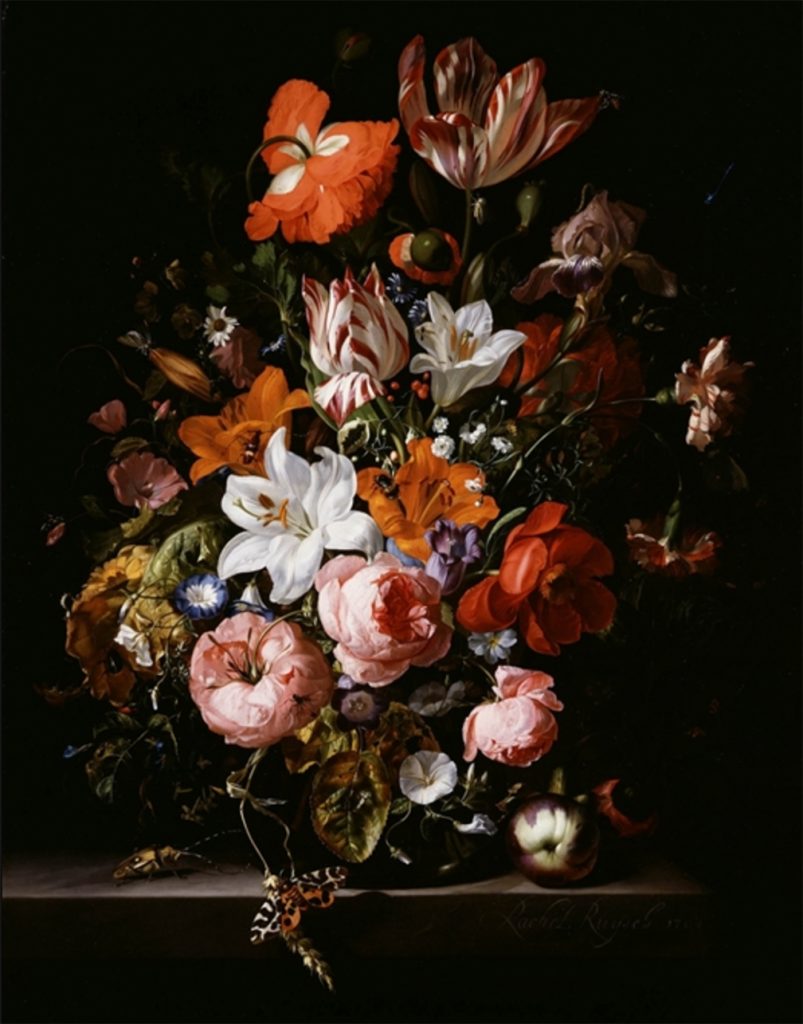
Flowers in a Glass Vase on a Marble Table by Rachel Ruysch (c. 1704)
I fell in love with Georgia’s white bones. They spoke to me of Life, of Death, of Eternity. In my classrooms with real skulls and at home with my plastic replicas, I took to drawing skulls. The subtle nuances of shading. The openings for eyes. The hollows and crevices. I felt that these skulls spoke to what was underneath our skin. What sturdiness we were made from. What held us together. A hidden part of ourselves. Her bones against the sky spoke to me of the eternity of life. The energy we dissolve into when we are no longer alive. A transition from being alive. The remnants of who we were when we left as a remembrance of sorts. The blue sky shining through those hollow bones. A signal of transition to another plane of existence.
There is another connection I felt with Georgia’s skulls. As the first generation of my family to be born outside of the Netherlands since the 1600s, I have, of course long been attracted to the vanitas paintings of the Dutch painters. Rachel Ruysch was a painter from the late 1600s into the 1700s who specialized in painting intricate and detailed floral bouquets. Because the Dutch were more of a secular nation, their work focused on symbols to express meaning rather than religious subjects, which predominated in other countries. Often, skulls were included in Dutch floral still life paintings, as well as different representations of the fleeting nature of life. Upon close inspection, you will find beetles, ants, and insects nestled amongst the flowers. You’ll discover past-prime deterioration in the petals. These vanitas images reminded the viewers of fragility of life. These are the dark paintings I’d been somewhat aware of until Georgia’s work burst into my sight with sunlight.
At about the same time Georgia came into my life in the late 1970s, my extraordinary art history professor, Patricia Hills, began introducing us to contemporary women artists working in what would eventually be called the second wave of feminism. The two artists whose work spoke the loudest to me were Judy Chicago with her ground-breaking installation, The Dinner Party. I, along with thousands of other women, made a pilgrimage to see the work at the Brooklyn Museum, where I began to realize that hundreds and thousands of women throughout the world had been written out of history.
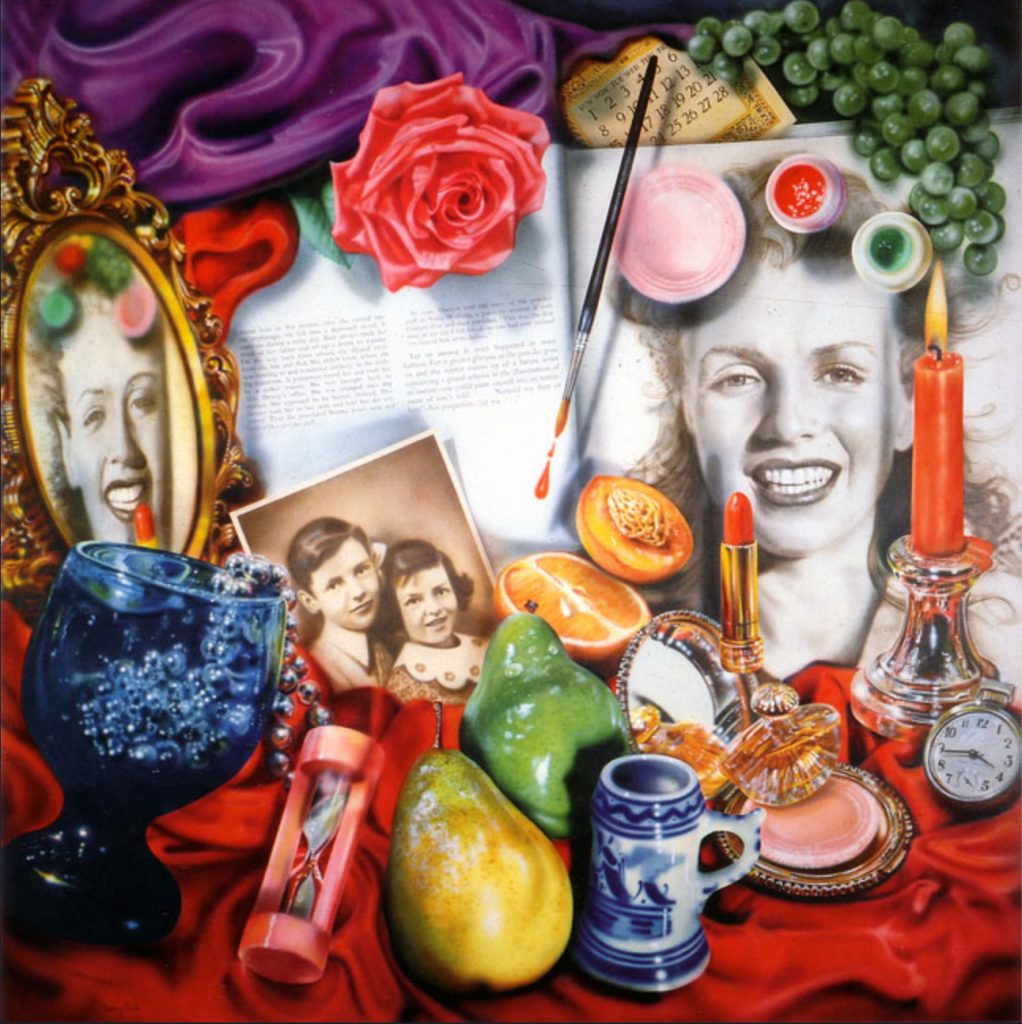
The photorealist Audrey Flack announced herself to me loudly with her large, air-brushed, and detailed paintings presented in a lightened palette of colors. This new take on the Baroque vanitas paintings of Ruysch filled me with ideas & expanded my vision in ways I’d never even considered. Her painting, Marilyn (Vanitas) of 1977, riffed on the subjects of transience and mortality. I realized that I was interested in painting ideas rather than painting objects. I wanted to stimulate thoughts, ideas, and conversations as these women had done for me.
I continue to walk boldly in the fading footsteps begun by these women. They showed me the immense courage it would take to keep creating my own vision, in my own way, in my own style. The world didn’t need their art. The world doesn’t need my art. But we need to create it, to put it out there to open the conversations, to spread ideas, to make statements, to provide warnings and to joyously celebrate being alive.
That’s a question I’ve heard more than once from people since I turned 70 some years ago. Why would I stop? Like everyone, my life has been a series of zigs and zags, some good, some less so. Life changes and we all adjust one way or another. Changing can be challenging but being flexible to new ideas and ways of doing things can provide a person with unexpected benefits, joys, and experiences.
Looking back on my journey, I realize that the flexibility I developed in navigating life’s obstacles has been a training ground for my future. We all have an outline of our story, and I’d like to share mine.
I got married, had kids, got divorced, went to college, and built a career. I’ve worked for others and then worked for myself. My kids grew up. I remarried, went back to college, changed careers, and changed directions. All that zigzagging presented opportunities for personal growth.
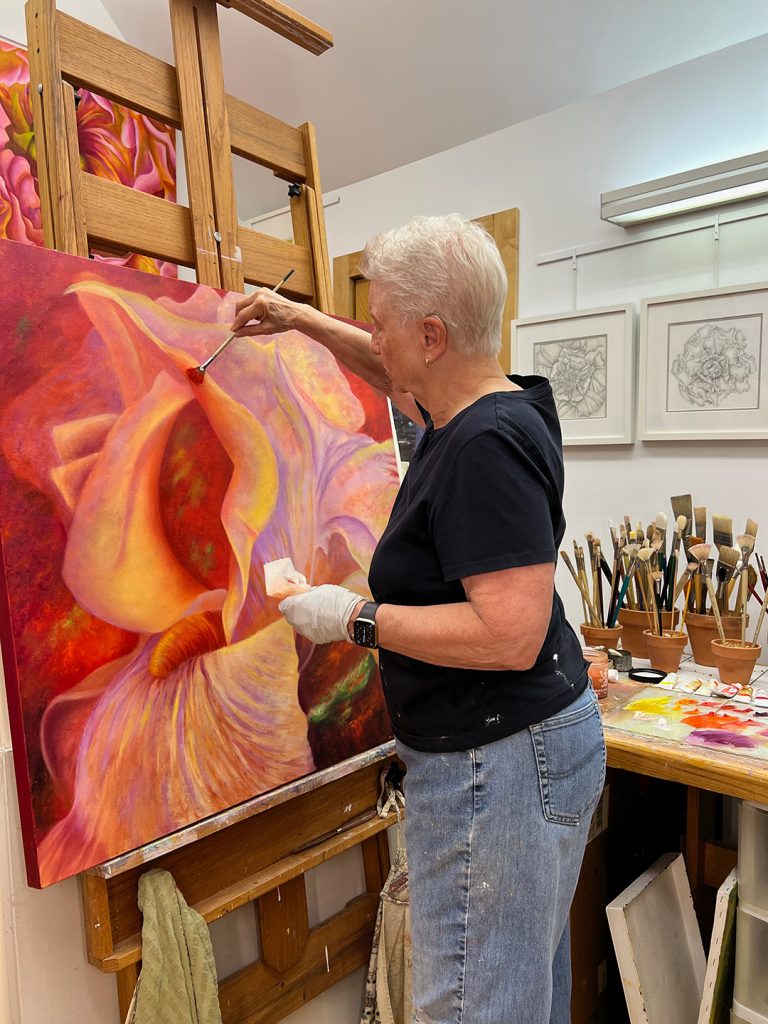
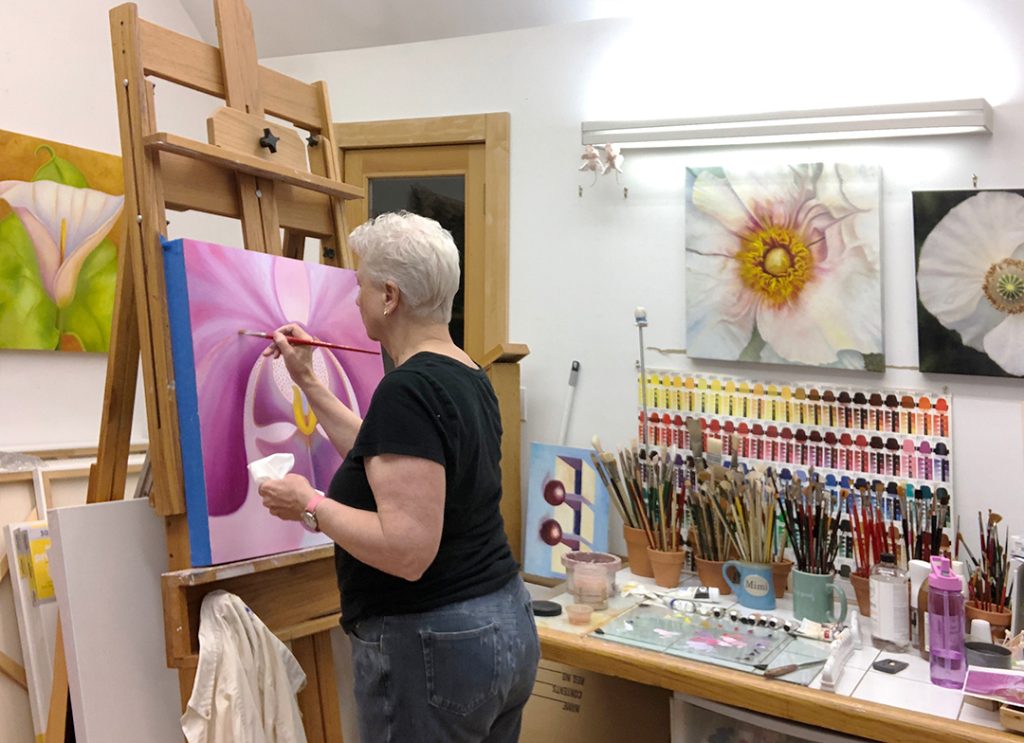
Mary Ahern in the studio working on the oil painting, My New World – Anemone-Redux
So here I am still active, creating my art, gardening, bike riding, traveling, taking classes in various subjects, and embracing the fullness of life. I’m also still actively working on websites, mine and others, publishing content on all my social media channels, writing marketing material for my work and other organizations, showing my artwork in multiple galleries, and giving artist talks to various audiences.
I’ve made changes that have enhanced this stage of my life. Aging happens along with aches and pains, plus other assorted gifts. How does one zigzag around that? How do I keep doing what I love and remain active and engaged despite the challenges?
I made a creative pivot from digital painting back to my original love, oil painting, when my hips began complaining to me that I was sitting too long. My hours and years at the computer spent working on websites, writing, and creating my digital art were affecting the quality of my life. I changed my direction. When I paint in oils, I stand. Standing helped to ease my hip and lower back pain.
Changing my art medium and process also gave me the unexpected benefit of exploring new styles and directions for my art. I began thinking about my art differently, which made the work I was creating look different. The long quiet hours of painting in my studio awakened a dormant passion and deep contemplation, something that didn’t happen when working with the overstimulation of computers. My hip pain offered me the opportunity to free myself and to grow from the experience.
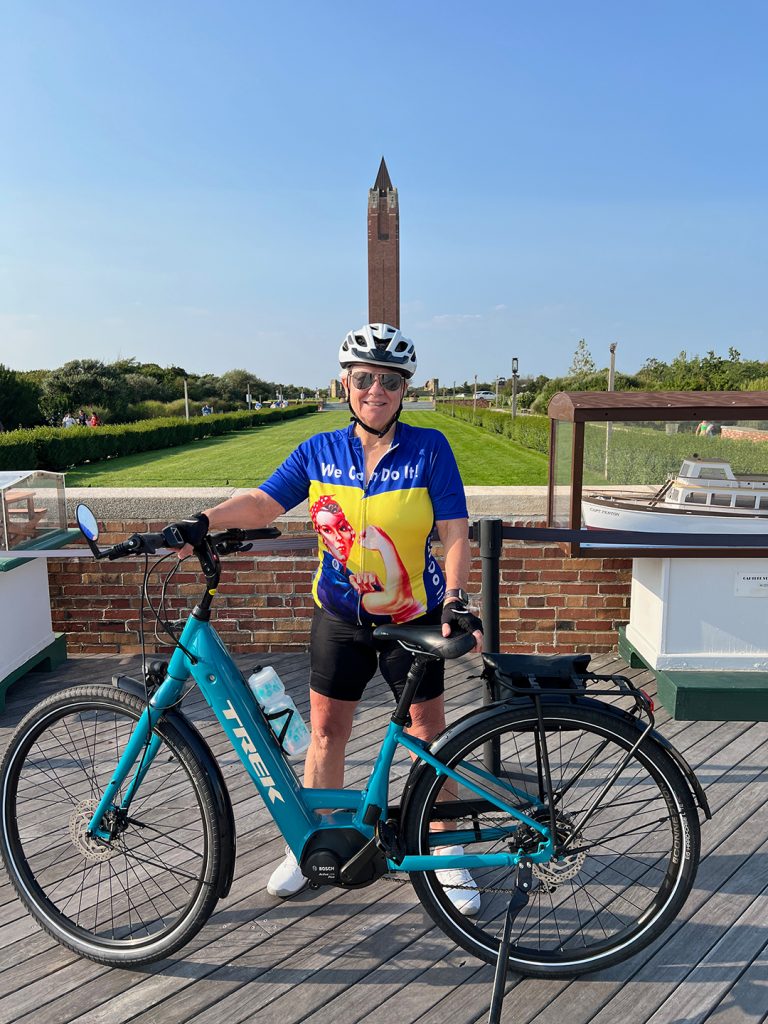
Physical adaptations have also helped. As a lifelong bike rider, the fun decreased with the increasing wrist and neck pain I had on each ride. I found myself making excuses not to join my hubby on the invigorating rides we had always enjoyed together. We were both feeling a sense of loss without trying to burden each other. But then, a solution presented itself in the form of an e-bike. This was another major and very welcome change. Buying my e-bike had me fall in love all over again with riding. I’d missed the breeze on my cheeks, the birds chirping as I rode by, the glimpses of wildflowers along the bike paths, and the fun of sharing the rides with hubby. Once I could ride again, we began taking bike cruise vacations since I could ride the daily 35-mile trips again. We became adventurers together.
Bike riding at Jones Beach, Long Island, NY.
Staying strong and healthy is critical, so I work out at the gym twice a week with a trainer who specializes in functional training. His exercise plan keeps my muscles active and strong, which I need for balance, lifting, bending, and other tasks I do in my everyday life. It’s helped me with my bike riding, gardening, and even more mundane tasks, like food shopping.
I have been able to take advantage of some medical adaptations too. When my eyes became too blurry, I had cataract surgery. When I found myself saying “What?” all day long, I found relief, as did my friends and family, with my new hearing aids. The unexpected bonus was being able to listen to my music and audiobooks through these devices without bothering others around me.
In my garden, I’m downsizing the amount of effort it takes to maintain the landscape I’ve created over the years. I’m planting fewer perennials and more flowering shrubs. I’m also planting more flowers in containers on my deck, which makes it easier for me to care for them. This downsizing allows me to continue to enjoy the garden without enduring the time-consuming and exhausting work of upkeep.
For safety issues, I’ve stopped climbing ladders to rehang the artwork in my studio as it comes and goes from and to art exhibitions. I have learned to ask my grown grandson to help me. He works for bacon and eggs on bagels, and we both get to enjoy each other’s company.
Investing in myself is critical to me, so I also invest in my passion for lifelong learning. This year, I’ve been working with AI to learn how to use it efficiently. I’ve also been taking a course on “strategy” since having a strategy can be applied to so many actions. It has helped me realize that my zigzag life, navigating everything that has come my way, has been a deliberate strategy for how I’ve lived life fully.
The detours, downsizing, and accommodations I’m currently making aren’t negatives at all; they are my strategies for aging gracefully. In fact, they are helping me to grow and continue doing the things I enjoy. I believe that this mindset is the framework for living as full a life as possible at any stage of our lives.
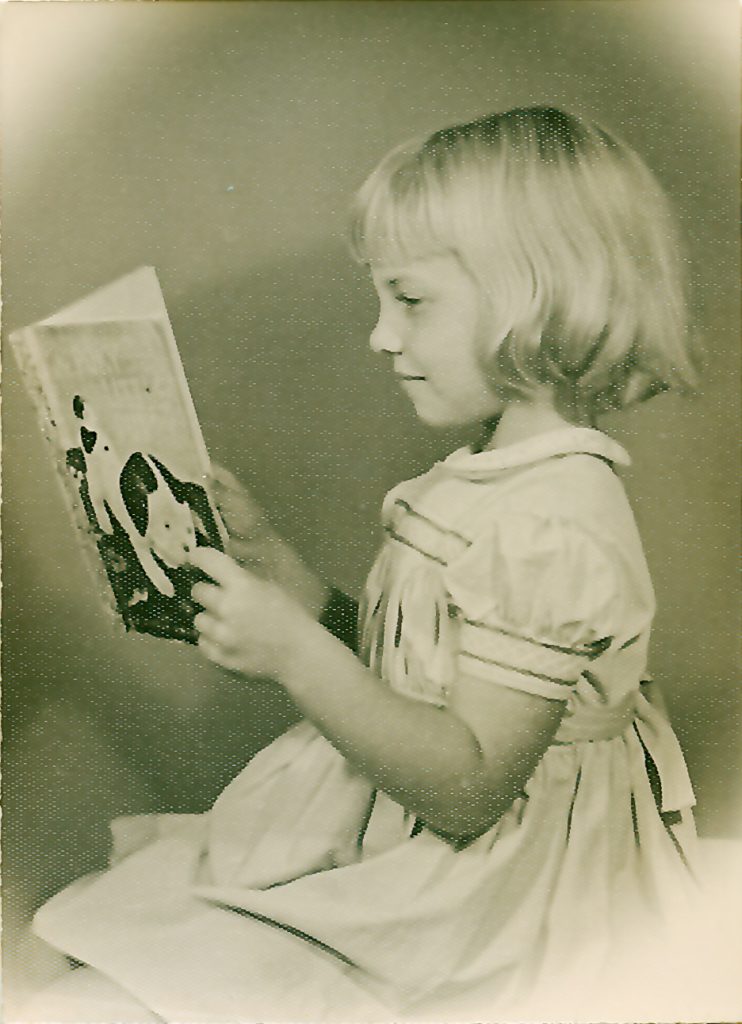
A Love of Reading from the Start Mary Swart Reading The Poky Little Puppy (1953)
I’m in my 70s and very excited since I’m back at school and taking a new class. We are so lucky now that there are many ways to continue learning. We can take classes in traditional in-person settings, take online workshops, or pursue a hybrid balance. What a gift!
My pursuit of knowledge has always been eclectic. I study what I want, when I want or need it, to enhance the projects I’m working on. Not one to seek the traditional BA, MA, or PhD stepping stones, I followed the song made famous by Frank Sinatra, I did it “My Way.”
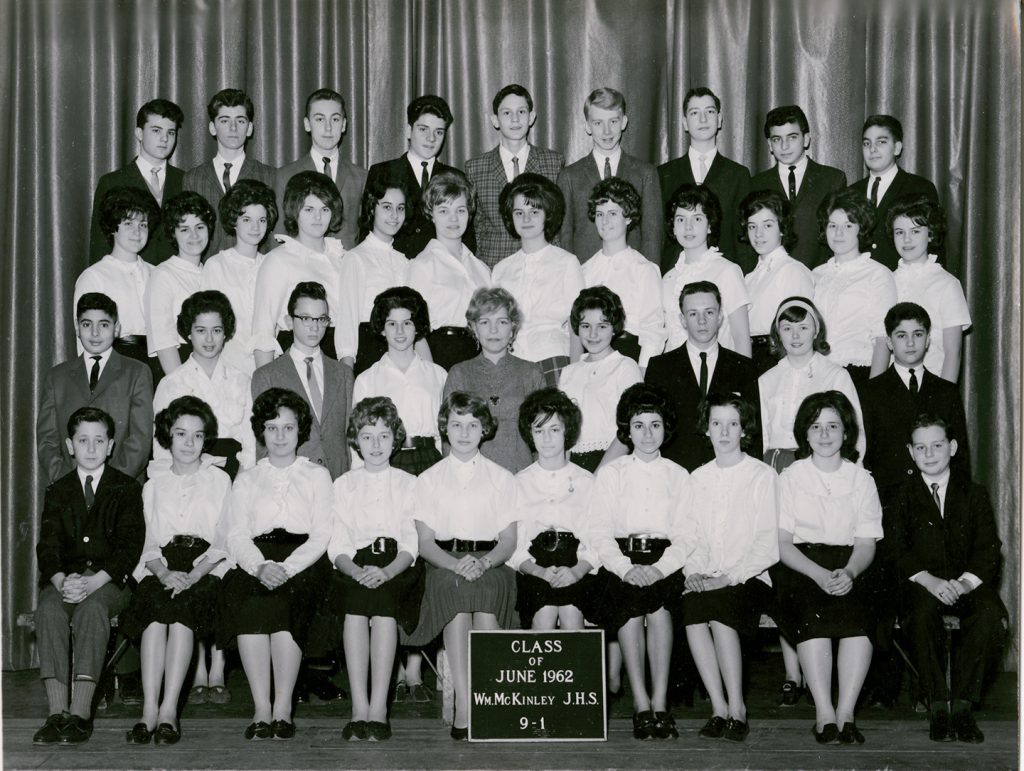
Mary Swart, McKinley Junior High School, 1962. Front row 5th from left.
One of the constants in my life is that I’m always studying something. A deep and wide curiosity leads me to focus on personal growth and practical knowledge — from Maharishi to computer programming and everything in between.
Starting college when my youngest entered pre-school gave me a late start to higher education. Once I entered the college classrooms, I experienced a surge of intensity for learning that has never diminished. In those earlier years, my studies were in traditional settings filled with students far younger than I was. It was fun to ruin the curve.
Online classes, initially offered by Lynda.com (now LinkedIn Learning), are how I studied in the mid-1990s as I balanced a full-time career while single-handedly raising my sons. These courses are brilliant orchestrations of various learning styles. This online coursework, consisting of 2-4 minute videos and written transcripts, runs the gamut of creative design, business, technology, and beyond. The subject offerings are now vastly more than in my original traditional classroom college settings.
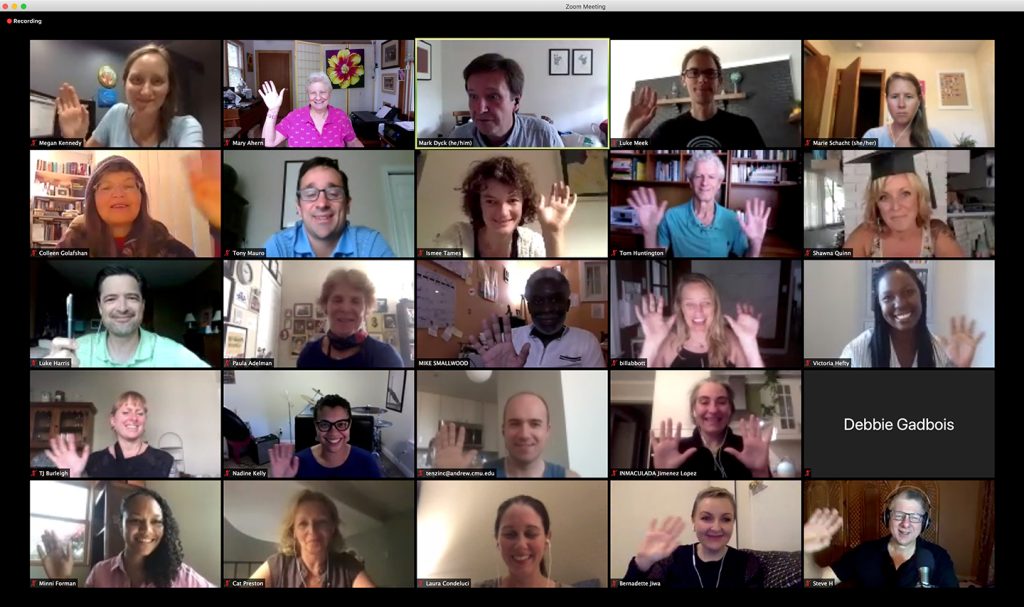
Screenshot of one of the online Seth Godin & Bernadette Jiwa Akimbo courses I took with other students around the world. It’s a great way to meet others who are interested in the same things as you.
On-site courses offer many benefits that I would not have had from in online settings.
My garden has been the inspiration behind my art for decades but formally studying horticulture introduced me to an entirely new understanding of the garden. Studying the science behind this living environment at my doorstep, was and continues to be a source of endless investigation. Not just in the beauty a garden can project, but in the sustainability, the interaction, and reliability of the vast array of life forms involved in creating a mutually dependent whole. Because of this deep study of my garden, my art has changed. As I’ve grown in an awareness of the complexity of the garden that I’ve designed and tended for over 35 years, my art has changed too by becoming more expressive, less realistic, and more multilayered.
I first became aware of how I was being transformed, not just by having more technical knowledge through my studies in horticulture when one day, standing in my garden, my clothes and hands covered in dirt, scratched and bug bitten, a wave of quiet contentment entered my very being. Yes, I was exhausted, and my body was aching from the hours of hard physical labor, but something different was flowing through my mind. It was a sense of awakening. I felt it but I was not able to articulate clearly what I felt. I still don’t have the words completely to express this transformation. So, I have been trying to do so through my art.
Working in my studio on the Phaelanopsis Orchid (December 2020)
Spending years since then of work both in my mind and physically, I have dug deeper into the metaphor the garden has represented to me about all living beings. It has taught me that in order to survive, the building of communities is needed to create a harmonic, healthy balance. The garden speaks to me of survival. I watch hummingbirds, with their long beaks, attracted to the long tubular flowers of the Salvias. I smell the late day fragrance of the Brugmansia as it seduces night pollinators less exhausted from a day’s work to help the lifecycle. Each insect, each flower, each fungus is only trying to survive for another season, another year, another generation. We as humans, like the complexities found in the garden are also trying to survive and hopefully prosper.
In my studio, my large, centrally focused flower paintings have been inspired by the imagery I saw through the microscopes used during my scientific studies in horticulture. The bold colors and large sized paintings were my way of grabbing the attention of the viewer just as the stunning presentation of a bold peony blossom calls out for attention.
Over time the education I am receiving from the garden has been changing me. My artwork Is reflecting my deepening thoughts, abstract concepts, and my openness to explore new ideas and deeper theories of the world surrounding us.
During Covid, another revelation presented itself to me. I began to look at the imagery posted online by NASA showing us the galaxy of which we are but a small part. I realized that the entire universe also depended upon that harmony and balance all of us, the garden included, must have in order to exist. This awareness of the delicacy of both the microcosm and the macrocosm of our worlds is what I am now trying to express in my artwork. Blending abstractions inspired by the cosmos transparently through the realistic flowers grown in my garden informs the current work in my studio.
The awareness of the multi-layered reliance on other forces to help in survival is humbling. This new awareness has deepened my gratitude. This is what I am now attempting to create in my studio.
Note: “Cosmic Phaelanopsis” is the final work after I put the piece aside for two years due to being dissatisfied with its direction. The final “Cosmic Phaelanopsis” is an example of the new direction my work has taken.
Partial Artist Statement:
This artwork sparks a vital conversation reflecting the interconnectedness and balance within the microcosm of my garden and the macrocosm of the cosmos. My work draws inspiration from the life cycle of flowers to explore existential questions about existence, purpose, fragility, and interconnectedness.
There were women who stepped into my life’s journey that changed the course of my life at critical junctures that I only realized in hindsight. I was raised in a very conventional household by strict European parents with very defined roles. By twenty years of age, I’d come to the pinnacle of my success with my prince charming of a hubby, a baby, and our own home. What a relief! I had it all. The American dream. Contentment personified.
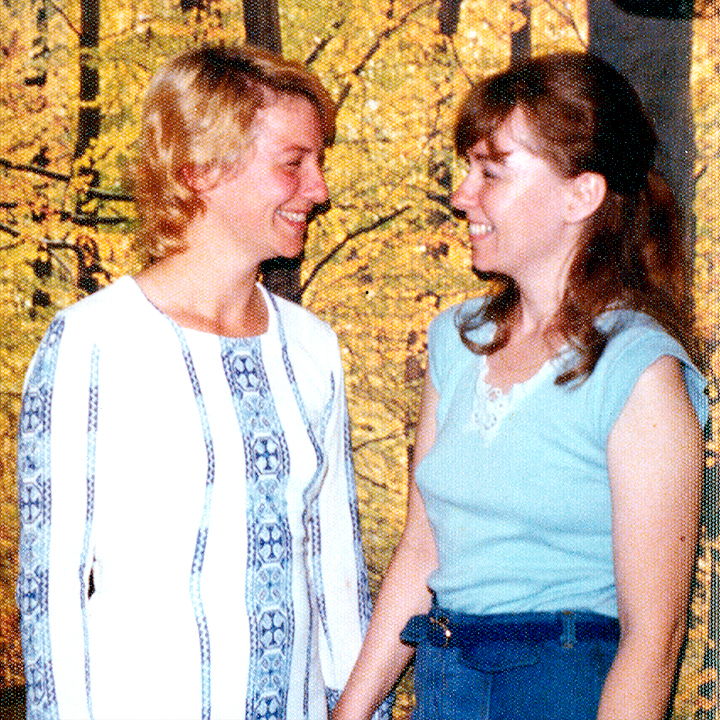
Mary (L) and Roberta ~ 1977 Photo Courtesy: Mary Ahern
Until my beloved hubby rocked our little world by wanting out of our paradise. I had no life preparation beyond anything except the happy home, two sons, a dog, and a white picket fence. I didn’t know any woman who worked, let alone was raising their children by herself. I honestly imagined my sons, and I would starve to death without a man to work and earn the money to use in the supermarket. The windows in our home became a prison to me, keeping us silently and painfully apart from the world. My dark hopelessness led me on frightening trails of despair and death.
The emergency slowly passed. Life settled down a bit. But I was changed forever. I knew I needed to control the outcome of life for my sons and me. Then, I met Roberta at the YMCA Swim and Gym classes for our three-year-olds. She was a biology professor at Queen College and showed me I could get educated. Because of her, I went to college, got my degree in fine arts, and then got my divorce on my terms.
With confidence and a goal, I got a job at Barnard College, the women’s college of Columbia University, a bastion of feminism—an entirely new world of supportive women who opened up a vast world for me. Martha hired me as the office manager since, as she said, any single mother knows how to balance time and tasks. Since classes were free for employees, I studied programming in the School of Engineering, and Martha encouraged me to get into the then nascent field of computers. She also said to follow where a company makes its money, so I should go into sales or finance for my career. I took her advice.
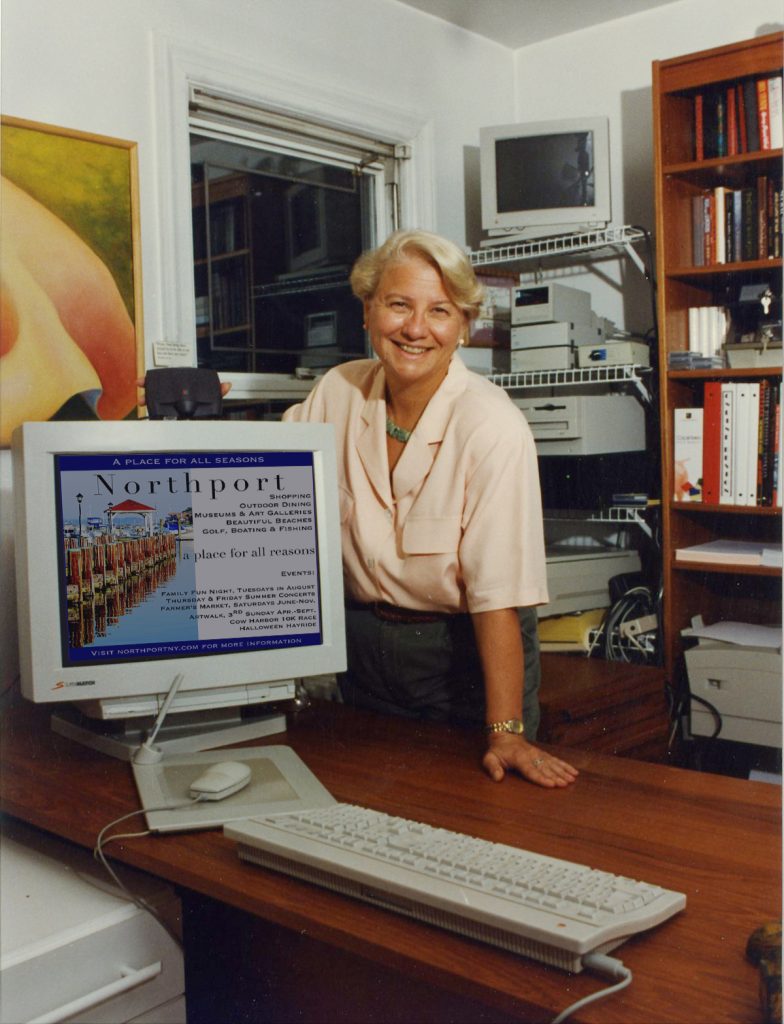
Mary’s Office Just After Starting Her Own Business, Online Design (1995) Photo Courtesy: Mary Ahern
Mary Ann had a Datsun 280 sports car, wore gold jewelry, and owned expensive houses. She showed me women on their own can be wealthy. I determined that if I couldn’t be home at 3 o’clock with the milk and cookies, I would make the most money I possibly could. She showed me it was possible.
I went into the sales field in the male-dominated computer graphics industry since there I would earn money based upon my own efforts while combining my art, graphics, and computer backgrounds. And I did. Until I hit my head on the glass ceiling. So, I started my own graphic design/marketing business.
As an entrepreneur, I controlled how I used my time, benefited financially from my own skills and efforts, chose the types of work that intrigued me and created and designed my own lifestyle.
And now is my time in my journey; I get to pay it forward. Using the models, the women before so wisely gave me, I am able to generously offer my experience to other women. Being an active member of the National Association of Women Artists (NAWA), I am in a position to share my business experience in sales and marketing with many other women to help them move along in their own journeys. Like having a delicious piece of apple pie with a scoop of ice cream and a cherry on top at the end of an exquisite meal, I’m finally having my dessert.
NAWA has been empowering women artists for 135 years as the first women’s professional art organization founded in the US. Like the women who helped me in my life’s journey, I’m comforted by knowing I’m also helping other women in theirs. As Isaac Newton said: “…if I have seen further than others, it is by standing upon the shoulders of giants.”
My life is filled with gratitude for what I have experienced and learned throughout my life, and that I now have an opportunity to share with other women in my community of professional women artists. Life is sweet!
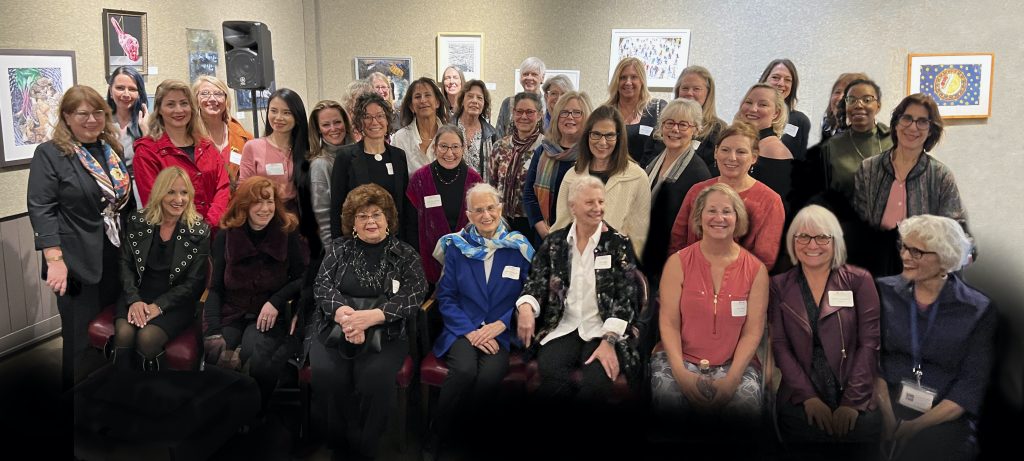
National Association of Women Artists (NAWA) 2023 New Member Induction Ceremony Mary (Bottom Row, 4th from Right) Photo Courtesy: Mary Ahern. Chair of Public Relations Committee