
How Not To See A Rhododendron
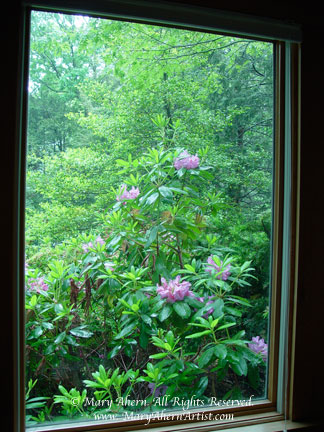
Rhododendron catawbiense in the window
Rhododendrons have such a great place in plant hunter’s history. Tales are still being told and re-enacted as new and old seekers traverse the back roads and non-roads of the Himalayas in search of the newest and rarest of Rhodies. Courage, stamina, and leeches always play a big role in these adventures.
Having quite a different perspective of plant hunting, I traverse the hills and dales of Long Island in search of the ever elusive cultivar not yet in my plant collection. Rather than being the intrepid adventurer of far off lands gathering seed, I drive to nurseries and make some of my decisions on whether I can lift the plant into my car. Rhodies can be backbreaking.
Which brings me to the problem of this Rhododendron catawbiense which is an original inhabitant when I bought the property in 1989. The foundation plantings were all huge view-concealing Rhodies. Over time I’ve managed to dig up and move all of them except this last remaining specimen. Some of the huge plants I moved by myself and in some cases, I hired a person with a bobcat. Some survived the transplanting and some didn’t. In retrospect, I think the fatalities had to do with watering and drought issues since the rootballs of Rhodies are pretty shallow and self-contained.
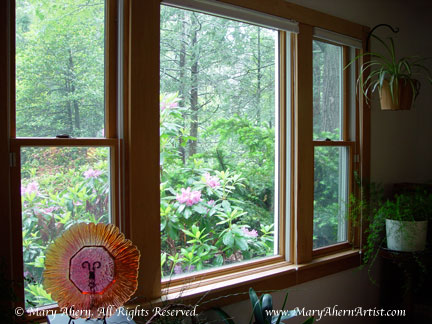
View from the dining room window of the Rhodi in bloom
The way to view Rhododendrons is not to the exclusion of a view of the rest of your garden when sitting at your dining room table. This view is only beautiful for 2 weeks a year when the rhodi is in bloom. The only other benefit to having this view is that in the winter you can use the leaf curl as a thermometer to determine if the temperature is below freezing. Not worth it I say. So, as I’ve said every year for the last decade or so, I’m going to move that Rhodie to the woods this year.
