Mary Ahern Artist - Botanical Art, Plant Portraits, Still Life and Shell Paintings

Don't forget to visit my website store to purchase Botanical Fine Art gifts for yourself, your friends and family.

www.MaryAhernArtist.com

______________________________

Posts Tagged “Gardening”

My garden doesn’t go into the winter season all tidy & neat. I enjoy seeing seed heads popping through the snow. The visual treat of shadows cast about by the wind, dancing along the walls seen from the windows of my warm home.

From my dining room window, the seed heads of tall grasses are seen swaying in the breeze with the floodlight of the pure winter sun behind them.

From the kitchen window the afternoon sun gleams through the slivers of peeling bark of the Acer griseum, wisely named Paperbark Maple. Tissue thin decorations provided by nature.

What a joy to watch teensy birds land on the seed stalks of last summer’s Echinacea, barely bending them. My winter garden provides them a smorgasbord of treats so they keep coming back for more. We have an agreement.

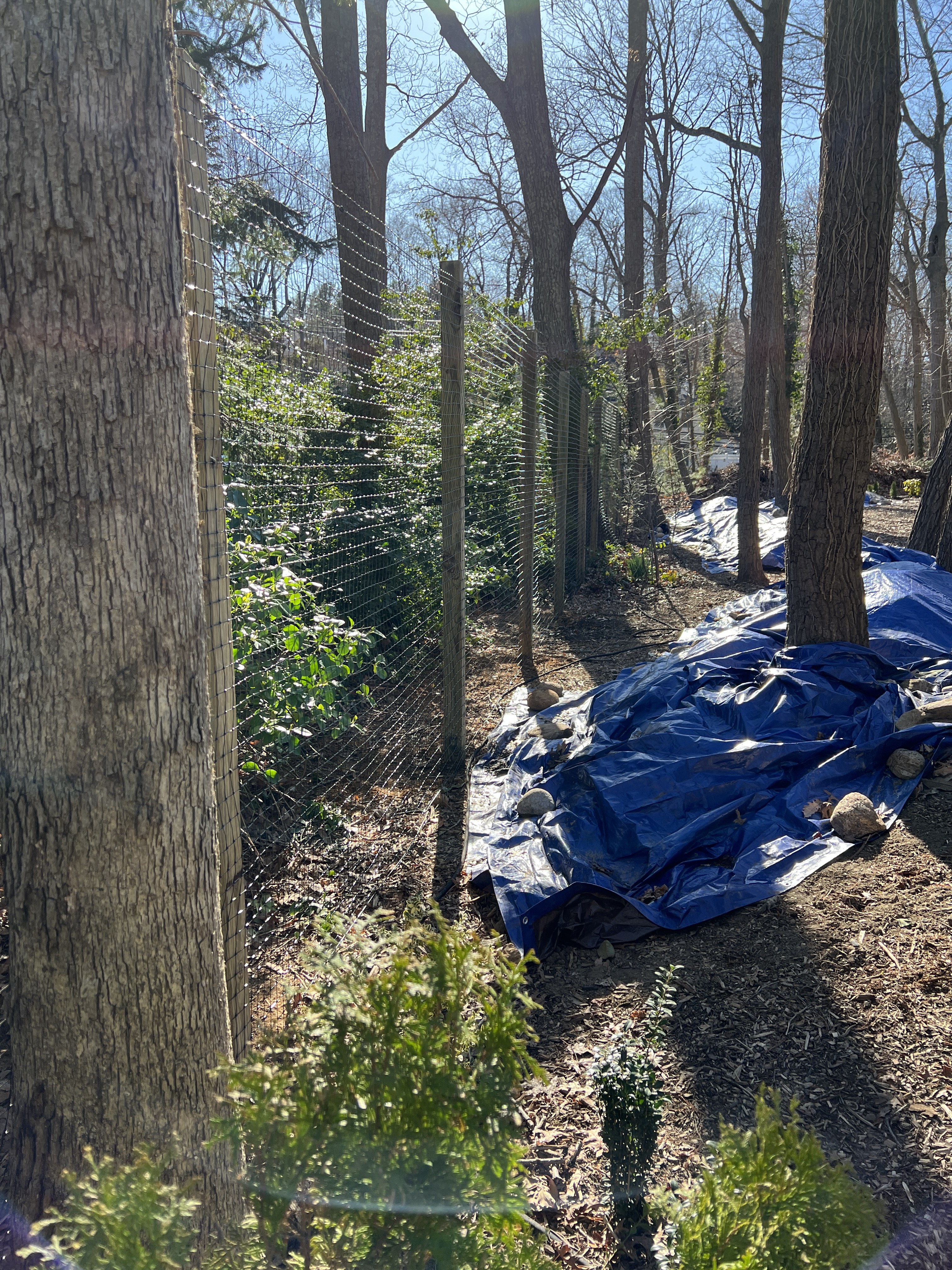
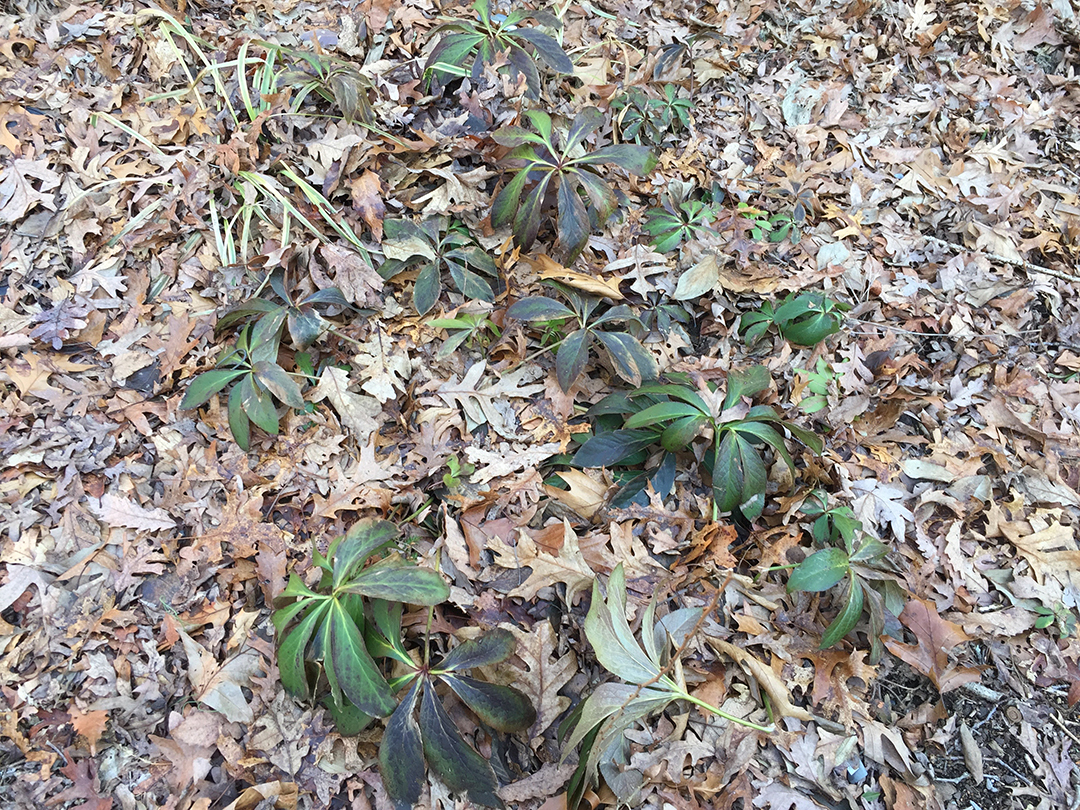
The evergreen stalwarts of my woodland garden, the hellebores & Polystichum acrostichoides (what a fabulous name for a Christmas fern), help to delineate the pathways once the snow has fallen. They’re markers keeping me on the right track. I need that help quite often.

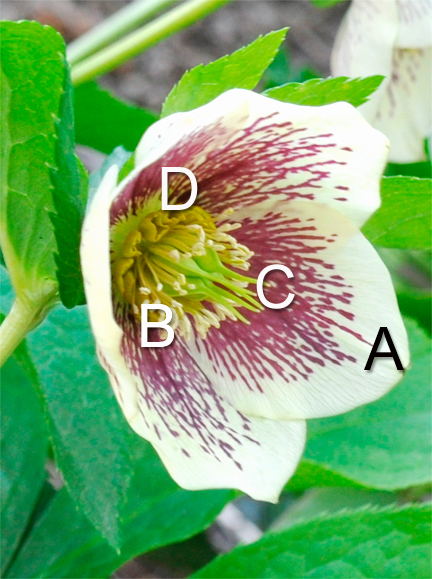
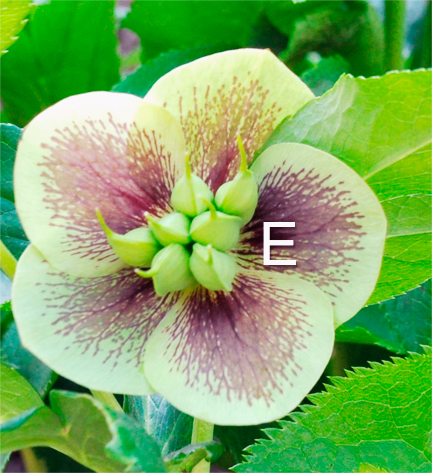
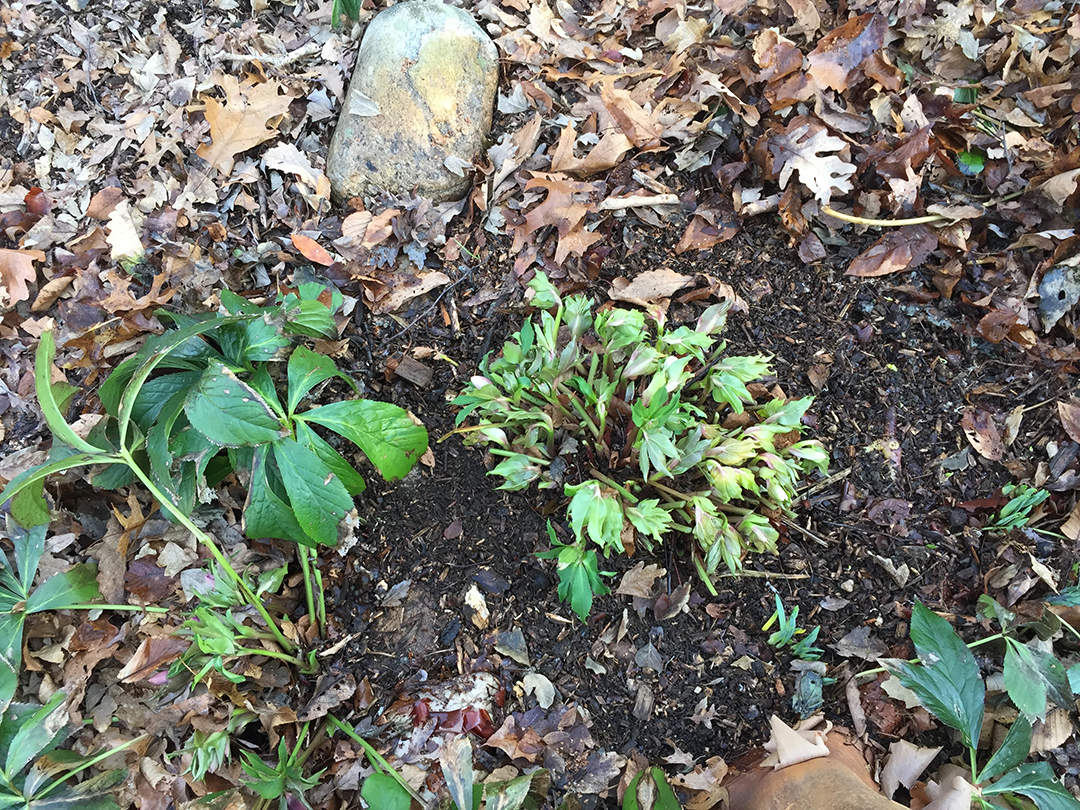
The hellebores serve another important service. They are the harbingers of spring. As I enjoy the subtle visual treats of winter I can’t help but poke underneath their large leaves seeking hungrily the buds signaling the beginnings of a new season of visual excitement.

Chasmanthium latifolium. Northern Sea Oats gracing my winter garden

_______________

Tags: , , , , , , ,

Comments Comments Off

One of the ways I plan for next year’s garden is to take a look around, make notes & gather ideas from other gardens. This is particularly helpful in planning the fall garden.

I look for what plants have continued to hold their own & still look beautiful into this time of year. I avoid looking for suggestions at the nurseries & gardening centers because those plants have been coddled, fed, trained, trimmed & produced specifically to entice you to buy them as your own garden fades.

Instead, I look at the gardens of my friends. Which plants are in bloom & in which colors? Which have stood the ravages of a long season of pests, fungus & weather to still look stunning? Which plants have resisted the need for staking & other high maintenance gardening chores?

Here are a few of the choices you’ll find in the fall garden:

Chelone lyonii 'Hot Lips'

Chelone lyonii 'Hot Lips'

Chelone lyonii ‘Hot Lips’

Turtlehead

This cultivar is a bit shorter than the Chelone oblique & the pink color a bit brighter. It needs no staking & reliably blooms for weeks on end. The dried heads look stunning in the winter sun as they’re popping up through the snow.

Angelica gigas

Angelica is a sturdy biennial, which reseeds conservatively in the mixed border.

This chest high specimen blooms on tall stalks with purple broccoli like flowers adorning them for weeks on end. Just be careful not to lose them by being to earnest in your springtime weeding or you’ll miss out on this fall wonder.

Kirengeshoma palmata

Kirengeshoma palmata

Kirengeshoma palmata

This 4’ tall and 4’ wide no maintenance fall blooming plant sports pearl like buds of yellow flowers in the shade garden. No staking, no pruning, no pests. Just sturdy, reliable performance.

Call your friends. Visit your neighbors. See what’s blooming in their gardens as you plan for next year’s fall extravaganza.

Tags: , , , , ,

Comments 1 Comment »

Why?

Deadheading the spent flowers on a rhododendron tends to focus the energy of the plant towards new flower production and general plant health. It also improves the sight of the plant when not in bloom.

How?

To deadhead, use your fingers and gently rock the base of the spent flower truss back and forth until it separates from the plant. That’s it. Now you can either toss the spent bloom under the shrub for mulch or discard on the compost heap. Your fingers might get a bit sticky from the residue but that’s part of the fun of gardening.

When?

I tend to deadhead my rhodi’s in the evening after I’ve worked all day in the garden and I’m strolling around to admire my work. I usually stop when it gets dark and that’s how I know it’s dinner time.

deadheading rhododendrons
After the blooms are spent it is beneficial to deadhead your rhododendron

______________________________

Tags: , , , ,

Comments Comments Off

NOTCHED LEAVES ARE CAUSED BY WEEVILS

Notched leaves on your rhododendrons are caused by a variety of species of weevils. The adult forms of the weevil tend to feed at night during the springtime when you’re resting after a hard day in the garden. The damage will not kill your plant, just cause unsightly notching on the leaves. Of course, the leaves being evergreen will be around awhile to annoy you.

rhododendron leaf damage
These notches on the Rhododendron leaf was caused by a weevil

• Hand pluck the critters.

One method of control is to go out to your garden in the evening with your flashlight and pluck the weevils from underneath the rhodi leaves and toss them into a bucket of water. This never appealed to me.

• Spray with systemic insecticide.

Another, more toxic method is to spray with a systemic insecticide, like Orthene. Make sure to follow the instructions on the label. Soak the leaves, both top and bottom as well as the soil underneath to get the best control.

• Accept imperfection.

The third method is to allow for a measure of acceptance of the notches and let nature take its course. Your neighbors will either respect your concern for the environment or talk about your lack of concern for aesthetics.

______________________________

Tags: , , , ,

Comments Comments Off

Generally speaking, cultural requirements are less “demanding” for lepidote (small-leaf) rhododendron and azaleas, both evergreen and deciduous. They tolerate, and to some extent require, more sun than elepidotes, and azaleas will also tolerate less well-drained soil. In all other respects, the general guidelines outlined above apply to all plants in this family.

Site Selection
Rhododendrons prefer a site that provides afternoon shade, some protection from wind, good drainage and air circulation. Sloping terrain is also a decided advantage.

Soil
Well-drained soil is a must. Use raised beds to plant on top of poorly drained soils. Ideally, soil should be acid (ph 4.5 – 6.0) and high in organic matter. Pine bark, coarse sphagnum peat moss, composted wood chips and other such materials can be worked into the soil to improve organic matter content and soil drainage. Incorporate a few handfuls of super phosphate (0-20-0) in the mix to stimulate root growth.

Planting
Container plant root balls must be sufficiently disturbed so that roots extend out from the ball. The planting hole should be wide but shallow. Loosen and amend soil only 8 – 10 ” deep so that the root ball sits on solid ground to prevent sinking. Plant only as deep as the top of the root ball with no soil on top of the ball. Do not pack soil tightly around the plant, as tender roots will be destroyed. Mulch 3″ deep and water thoroughly.

Rhododenron planting diagram
Rhododendron Planting Diagram

Mulching
Mulch with 3″ of pine bark, pine needles, oak leaves, composted wood chips or other loose airy material. Do not use maple leaves, grass clippings or other materials that pack down.

mulch
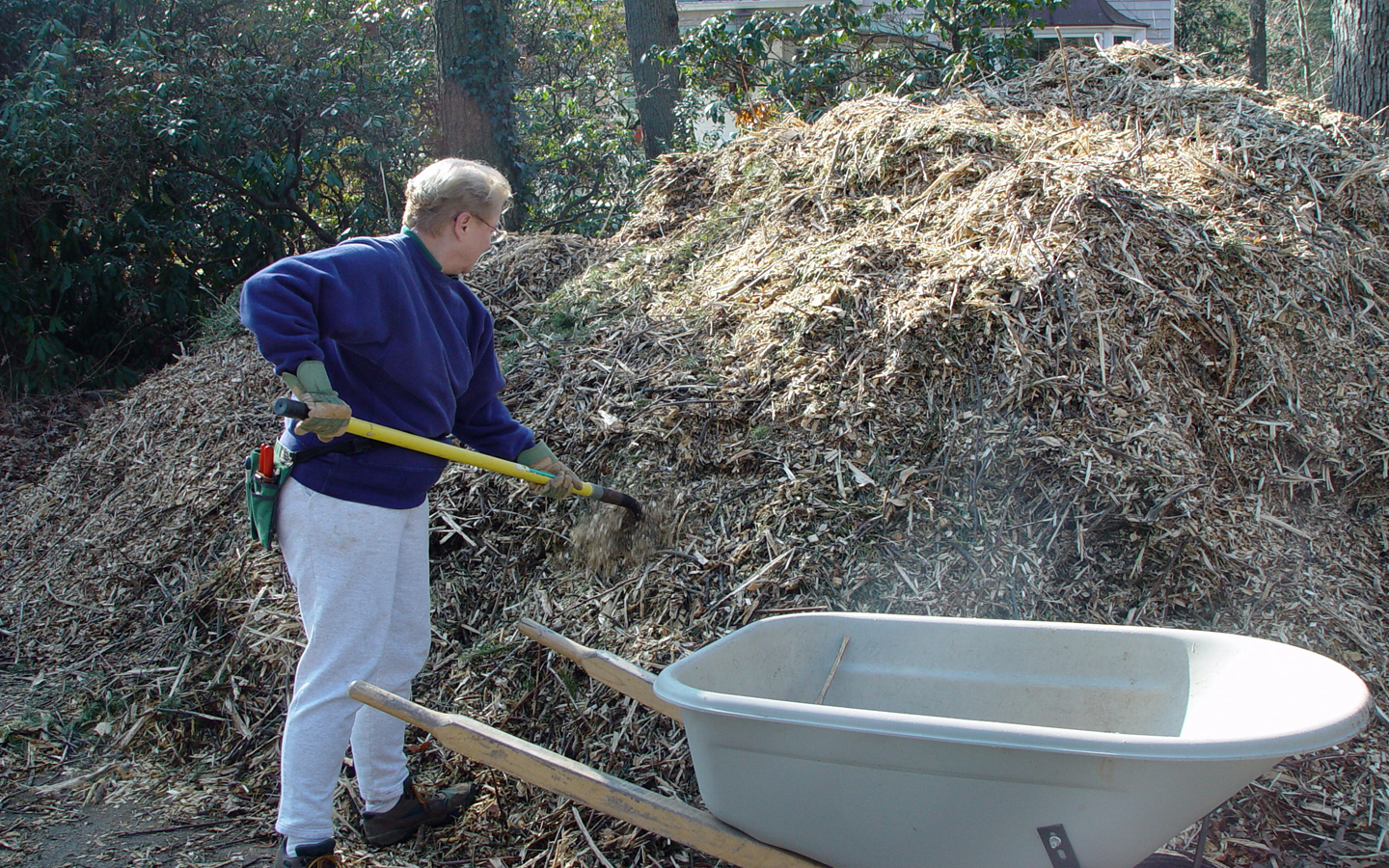
Loading mulch for placing under shrubs

Fertilizing
If plants hold good green color and grow well, no fertilizer is needed. Rhododendrons are not heavy “feeders”. A soil test can determine what elements are deficient if plants do not perform well. When necessary, apply a fertilizer formulated for acid loving plants in late winter or early spring. Don’t fertilize after June 1st.

Watering
Proper watering is an important after care practice, especially for the first several years as plants become established. Keep the soil moist but not wet. Water deeply, (apply 1″) in the absence of equivalent rainfall. Don’t water again until the soil starts to dry out. Afternoon wilting of new growth is normal. If leaves become turgid a few hours after sundown, no additional water is needed. Water requirements diminish in late summer and early fall as new growth hardens up for winter. Plants should, however, be watered going into winter following a dry fall.

Tags: , , , , ,

Comments Comments Off

This is part of an outline of a ten minute talk I gave to the Centerport Garden Club on November 9, 2010

HOW ARE RHODODENDRONS CLASSIFIED?

Rhododendrons are classified into two major groups, lepidote and elepidote?

  • Elepidotes are large leaved rhododendrons. They are the type of shrub that most individuals would associate as being a rhododendron. They do not have scales located on the underside of the leaves. Plants tend to be very large in their maturity.

    elipidote rhododendron

    Elipidote Rhododendrons have big leaves

  • Lepidote rhododendrons have smaller leaves and are usually low growing or dwarfs. They usually bloom earlier in the spring than the larger leaved elepidotes.

    lepidote rhododendron
    Lepidote Rhododendrons have small leaves

WHAT IS THE DIFFERENCE BETWEEN AZALEAS AND RHODODENDRONS?

rhododendron
Rhododendrons have 10 stamens, 2 per lobe

  • All azaleas are rhododendrons but not all rhododendrons are azaleas.
  • True rhododendrons have 10 or more stamens which is 2 per lobe. Azaleas usually have 5 stamens or 1 per lobe. Azaleas have 5 lobes in a flower
  • Azaleas tend to have appressed hairs which are hair parallel to the surface of the leaf. This is particularly true along the midrib on the underside of the leaf. It is easily seen in “evergreen” azaleas.
  • True rhododendrons instead of hair are often scaly or have small dots on the under side of the leaf.
  • Azalea leaves are never dotted with scales and are frequently pubescent.
  • Many azaleas are deciduous.
  • True rhodi’s are usually evergreen with the exceptions of R. mucronulatum and R. dauricum.
  • Azaleas have tubular funnel or funnel shaped flowers. Rhodi flowers tend to be bell-shaped.
    azalea
    Azaleas have 5 stamens, one per lobe
Tags: , , ,

Comments Comments Off

This is an outline of a ten minute talk I gave to the Centerport Garden Club on November 9, 2010

Botanical Classification

Rhododendrons and azaleas belong to the genus Rhododendron of the heath family (Ericaceae).

  • The heath family includes the heaths and heathers, blueberries, mountain laurels and several other ornamental plant groups.  Most members of this family require acid soil and good drainage.

Rhododendron collectionThis is a selection of the Rhododendrons submitted to the judging of the Spring Flower Show at the NY Chapter of the American Rhododendron Society at Planting Fields Arboretum

Where are Rhododendron’s from?

Some are native to the US.

The British became the first explorers to seek out new additions.

Collecting has brought plants, seeds & cuttings from Japan, China & the Himalayas.

New species are still being collected in central China.

In the 1800’s they were so expensive & were considered a rich person’s plant. They appeared on estates and in arboretums.

Most of the Rhodi’s we know today are hybrids created from the parents of the plants collected by these plant explorers.

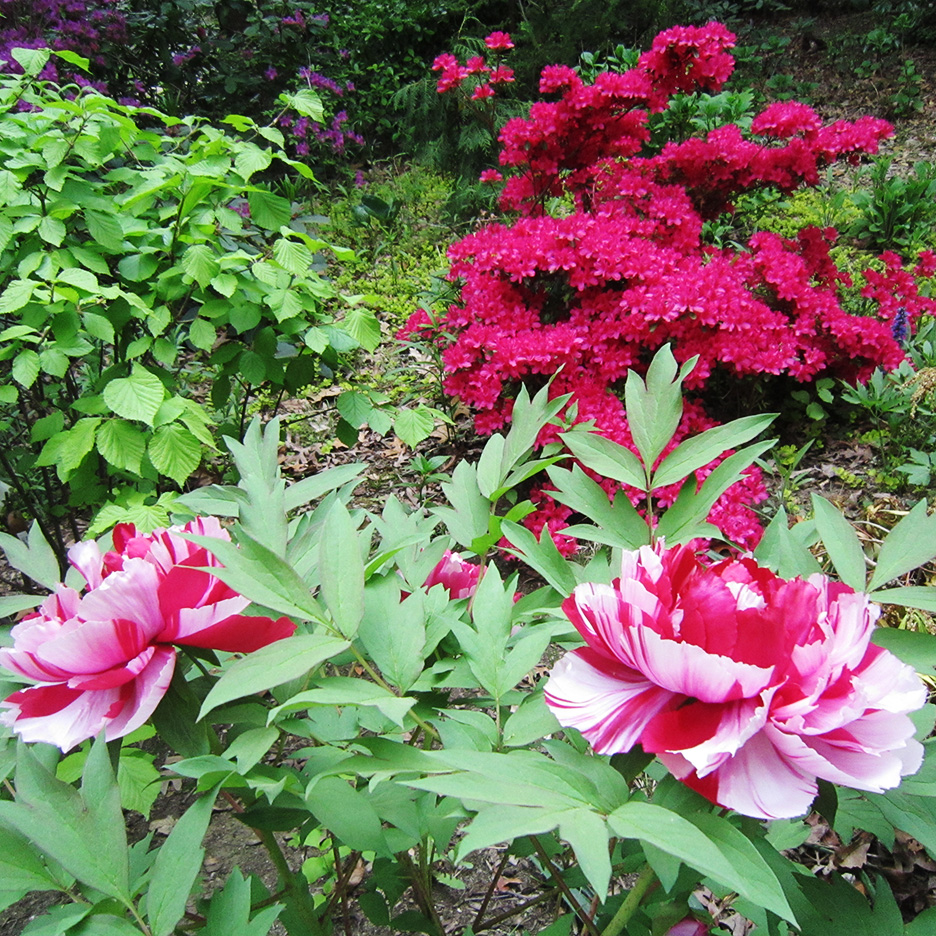
Azalea gardenAzaleas blooming in May in my garden in Northport NY

Common Types

  • Large leaf evergreen Rhodi’s: Great for screening and as a backdrop behind the flower garden, Catawbiense, English Roseum, Scintillation, Maximum
  • Small leaf evergreen Rhodi’s: some sport beautiful mahogany leaves during the winter months, Aglo, Dora Amateus, Mary Fleming, the PJM’s
  • Yakushimanum hybrids: usually 3’wx3’h with woolly indumentum on dark green leaves. Have wonderful winter interest, Crete, Fantastica, Ken Janek, Percy Wiseman, Prince & Princess
  • Species Rhododendrons, can present well in a mixed flower, shrub border. There is a species rhododendron garden in DC.
  • Azaleas-Evergreen: Michael Dirr begins his Azalea Cultivar & Hybrid Group section with:

“In some respects, it is paralyzingly frightening to attempt to present the cultivars of azaleas.”

There are so many but you can begin to study them realizing that some are named for their hybridizers: i.e. Girard Hybrids, Glen Dale Hybrids, Polly Hill’s North Tisbury Hybrids. Others by their location: i.e. Linwood Hybrids, Karume Hybrids of Japan.

_____________________________________________

Tags: , , ,

Comments Comments Off

On January 5, 2008 I was featured in an article in Newsday titled “Dream Chasers.” The subject was the choices and sacrifices some people make when deciding to step off the corporate treadmill in order to pursue more emotionally or spiritually rewarding careers without regard to financial restraints.

The author of the article, Arlene Gross, wrote about the choices, decisions and sacrifices of five different individuals. The various paths we chose to explore in our second careers are as different as our paths in our initial and primary wage earning pursuits.

Noel Rubinton, the editor of the Act Two section of Newsday, however, hit on a different issue when he encouraged people to use the New Year as an opportunity to explore yourself even if you couldn’t at this time make the giant leap of a whole new career.

Noel wrote that, “A line that really resonated in our cover story came from Mary Ahern… finding that switch took work. ‘The hard part at first was trying to find inside myself what that dream actually was. You spend so much time marching forward and doing what you do, you lose the essence of yourself’.”

When my husband Dave gave me as a wedding gift, which coincided with my 50th birthday, the opportunity to re-invent myself you would think I would have immediately jumped into my studio. Instead I whined and anguished for a months over what I wanted to do with this great new vista open to me.

I was so overwhelmed with the immense possibilities I now had available to me that I suffered each day trying to make the right decision with this precious gift. I spent so much time trying to fathom what makes me tick, what intellectually interests me, what direction would support my value system, what new career would be feasible and sustainable for the next 30 or so years, what would not impinge on the home life that we had just found together and cherished so much.

I talked about it endlessly. I beat it to death. I’m sure there were times that Dave wished he hadn’t made the offer since I was so annoying in my pursuit of the “what if’s”. Massage therapist? Lawyer? Chiropractor? Quite frankly, I never even considered Artist.

I knew one thing for sure. I was tired of computers and wanted to become a Luddite. And then one Saturday morning, sitting on our deck having coffee surrounded by the gardens I designed and have worked on for decades, Dave suggested that since we loved the gardens so much and they gave such joy to people, why not design gardens for others.

BANG!

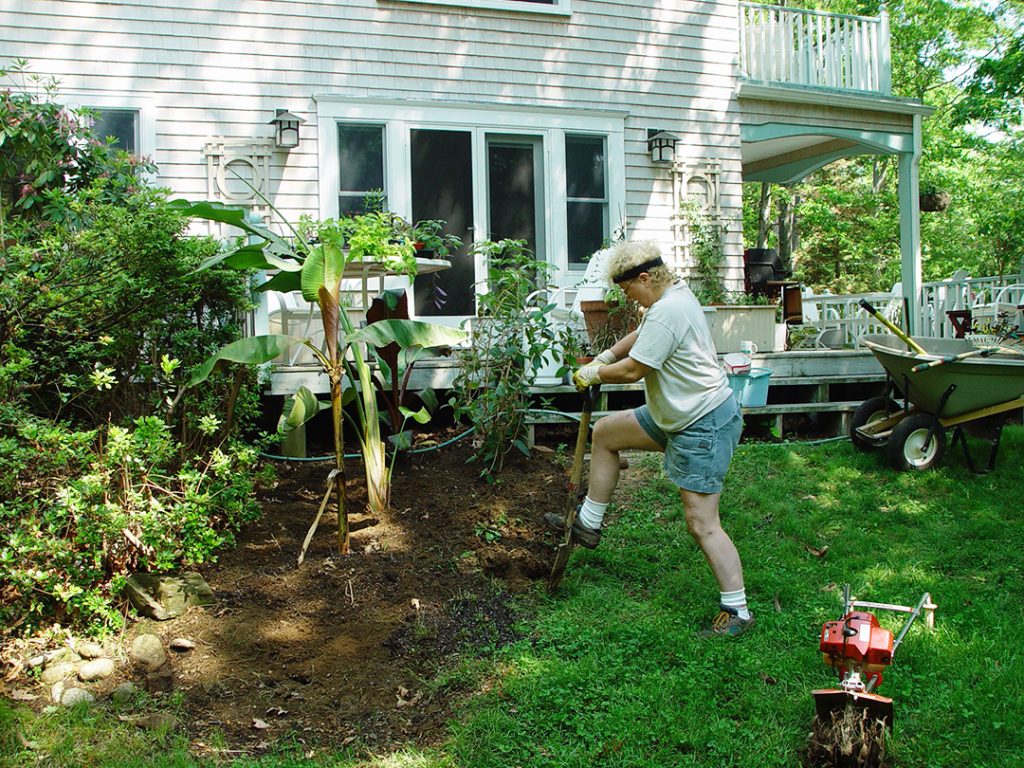
2002-05 Mary planting her tropical garden Ten days later I was enrolled as a full-time student in the Ornamental Horticulture Program at Farmingdale. I knew I wanted to be a landscape designer and this was the best beginning. Two years later I graduated with my degree and a new career.

Tags: , , ,

Comments Comments Off

Don't forget to read my Art Blog entitled: Art Naturally - Musings Of My Life As An Artist.